

Here’s what a typical day for a telecalling team often looks like: they dial one number, it rings out; they dial the next, it’s busy; and the third call goes straight to voicemail. By the time someone actually answers, twenty minutes and four missed connections later, the rep has to scroll back through the sheet to remember who they were calling and why. Multiply that across a team of fifteen agents and a full working day, and the maths gets ugly fast.
For outbound-heavy businesses, that lost time has a direct, measurable cost. To close this gap, auto dialer software has become an important tool for any call centre in India. Instead of agents dialling one number at a time, the system dials automatically, filters out busy lines, switched-off numbers, and voicemails, and connects agents only when a real person answers. What’s left is more conversations, faster follow-ups, and a CRM that updates itself. We’ll take a look at the most promising options available on the market.
8 Best Automatic Dialer Software in India
Indian market is highly competitive. While speed-to-lead and outreach volume are the lifeblood of business growth, manual dialling wastes productivity. According to the Salesforce State of Sales Report , sales reps spend only about 30% to 35% of their working time actually selling. The rest disappears into admin work, data entry, listening to unanswered caller tunes, and dealing with dead phone lines.
Auto dialer software works through a list of numbers or a CRM, and connects the call to an agent only when a real person is on the line. Simply put, it takes over the mechanical part of outbound calling. It also logs the outcome, records the call, and schedules the next follow-up in the background without any manual input. Cloud-based dialling platforms instantly eliminate agent idle time and double call-connect ratios.
1. Runo: Best Overall for SIM-Based Calling and AI Call Intelligence
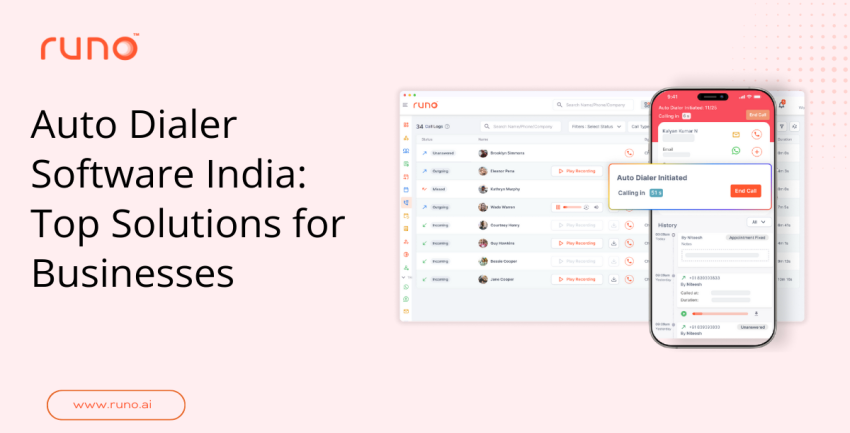
Runo routes calls through a SIM-based mobile network instead of VoIP. Recipients see a standard Indian mobile number rather than an unfamiliar or flagged one, which solves the connect-rate problem with sales calls. Additionally, it pairs with a native CRM, meaning the dialer and lead management were built as one product rather than bolted together.
Key features:
- SIM-based and cloud dialling in a single mobile-first platform
- AI-generated call summaries, sentiment scoring, and talk-time analytics on every call
- Built-in CRM, WhatsApp automation, and automated lead allocation
- TRAI/DND compliance controls and audit-ready call logs by default
- Native integrations with Zoho, Salesforce, HubSpot, LeadSquared, and IndiaMART
Best for: SMBs and mid-market outbound teams in India that want high connect rates, AI call analytics, and a built-in CRM.
2. Ozonetel: Best for Large Omnichannel Contact Centres
Ozonetel is a DoT-licensed cloud telephony and contact centre platform used by thousands of Indian businesses. It supports multiple dialling modes alongside a full omnichannel suite. Integrated AI capabilities include conversation analytics and quality audits.
Key features:
- Predictive, power, and preview dialling in one platform
- AI-powered IVR with multi-level intelligent routing
- Omnichannel support across voice, SMS, WhatsApp, and chat
- Real-time dashboards with live call and agent monitoring
Best for: Mid-to-large enterprise contact centres running blended inbound and outbound operations across multiple channels.
3. Exotel: Best for Enterprise-Grade Reliability at Scale
Exotel is one of India’s most established cloud communication providers, built on its own DoT-licensed telecom infrastructure. Large consumer platforms use it for high-volume outbound calling. Its number-masking feature is widely used in logistics, gig-economy, and BFSI applications where caller privacy matters.
Key features:
- Auto-dialer and predictive dialer built for high-volume campaigns
- Number masking for privacy-sensitive use cases
- Programmable call-flow APIs for custom integrations
- DND scrubbing and compliance controls built into the platform
Best for: Enterprises and large-scale outbound operations that need carrier-grade reliability and deep API control.
4. MyOperator: Best for SMBs Wanting a Simple, Fast Setup
MyOperator is a widely adopted cloud telephony platform among Indian small and medium businesses, valued for its plug-and-play setup. It combines outbound calling, IVR, and WhatsApp Business in a single mobile-friendly platform.
Key features:
- Power and progressive dialling with CRM sync after every call
- Multi-level IVR alongside outbound campaign tools
- WhatsApp Business API integration
- Mobile app built for field and remote agents
Best for: Indian SMBs that want an easy, budget-friendly cloud calling platform with minimal setup time.
5. FreJun: Best for AI Transcription on a Budget
FreJun is an India-native cloud telephony platform. It is positioned as an accessible alternative to enterprise-priced platforms for teams that still want AI-powered post-call automation.
Key features:
- AI predictive dialer with real-time call pacing
- Automatic transcription and AI-generated call summaries
- One-click sync to Salesforce and HubSpot
- Post-call surveys and performance dashboards
Best for: Small to mid-size sales and support teams
6. Knowlarity: Best for Regulated Enterprise IVR Workflows
Knowlarity has a long track record in running complex, multi-level IVR alongside high-volume outbound campaigns, particularly in sectors where both structured call flows and regulated calling matter.
Key features:
- Voice broadcasting for large campaigns
- Multi-level IVR with time-based routing logic
- Toll-free, virtual, and local number provisioning across India
- Call recording with CRM sync for compliance documentation
Best for: Enterprises in BFSI, insurance, and real estate
7. Servetel (Acefone): Best Budget Option for Basic Outbound Calling
Servetel, now operating under the Acefone brand, offers cloud telephony at competitive rates. It focuses on dependable IVR and basic outbound calling rather than predictive dialling or advanced AI.
Key features:
- Virtual and toll-free number with IVR
- Call recording and dashboard performance reports
- Voice broadcasting
Best for: SMBs that need reliable service without paying for features they won’t use.
8. CloudTalk: Best for International or Distributed Teams
CloudTalk is built primarily for globally distributed sales teams. It supports almost all dialling modes along with a solid AI analytics layer. With local numbers available across 160-plus countries, it is a good option for international sales calls.
Key features:
- Power, parallel, progressive, and preview dialling modes
- AI call summaries, sentiment analysis, and talk-to-listen ratio
- One-click voicemail drop
- Local numbers in 160+ countries
Best for: India-based companies making significant international outbound call volume or managing globally distributed reps.
| Platform | Calling Type | Native CRM | AI Features | Best For |
| Runo | SIM-based + cloud | Yes | Call summaries, sentiment, talk-time | SMBs & mid-market, Mobile-first calling & field sales teams |
| Ozonetel | Cloud/VoIP | Via integration | Conversation analytics, IVR AI | Large omnichannel contact centres |
| Exotel | Cloud/VoIP | Via integration | Limited | Enterprise-scale reliability |
| MyOperator | Cloud/VoIP | Via integration | Basic | SMBs wanting fast setup |
| FreJun | Cloud/VoIP | Via integration | Transcription, summaries | Budget-conscious AI adopters |
| Knowlarity | Cloud/VoIP | Via integration | Limited | Regulated enterprise IVR |
| Servetel (Acefone) | Cloud/VoIP | Via integration | None | Budget basic outbound |
| CloudTalk | Cloud/VoIP | Via integration | Summaries, sentiment | International/distributed teams |
Why Auto Dialer Software India Is Growing So Fast
According to TRAI Telecom Subscription Data , by June 2026, total telephone subscribers passed 1.3 billion, with wireless tele-density at 94.31%. For any business selling by phone, that’s both an opportunity and a warning. With that scale of mobile usage, outbound calling remains the primary channel for lead engagement in the Indian market, in both the B2B and B2C sectors. This also explains why the country’s contact centre software market is projected to grow at a 15.4% CAGR through 2032, per the 6Wresearch India Contact Center Software Market report.
Shift towards automated, mobile-first dialling software has accelerated sharply over the past few years because:
- Outbound-heavy sectors such as real estate, BFSI, EdTech, logistics, and D2C depend on speed to lead, i.e., reaching a prospect while interest is still high. A prospect who submits an enquiry and doesn’t hear back within minutes is far more likely to go cold or convert with a competitor.
- Indian buyers tend to answer calls from recognisable local numbers far more readily than from unknown VoIP IDs, pushing demand toward SIM-based and hybrid dialers.
- Sales teams need a system that works as well on a mobile phone in the field as it does at a desk. A mobile-first platform such as Runo’s auto dialer has gained strong traction with SMBs, because it runs on ordinary SIM cards and doesn’t require a full call centre setup to get started.
How Auto Dialer Software for Call Centre Operations Works
Most auto phone dialer software runs on one, or a mix, of four dialling modes, and the one you choose should match your campaign type.
- Predictive: for high-volume outbound, large teams where the software predicts when an agent will be free and dials ahead of time
- Power: for mid-sized teams that need a steady, no-gap pace. It dials one number per agent, right after the previous call ends.
- Progressive: dials the next number only once an agent is free, and shows lead details before the call connects.
- Preview: ideal for high-value, relationship-led sales such as enterprise or real estate deals, where the agent reviews full lead history before dialling at all
- Preview dialer: for high-value conversations, where the agent reviews full lead history before dialling at all.
Don’t buy a platform that locks you into a single mode. Different campaigns need different paces, and a well-built call centre dialer should let you switch between these modes.
Must-Have Features in Auto Phone Dialer Software
Not every auto phone dialer software on the market is built the same way. So, before deciding the right one for you, some features that you must consider include:
Multiple dialling modes
Predictive, power, progressive, and preview, so the tool fits more than one campaign type.
CRM and lead-source integration
Native or API-based sync with platforms such as Zoho, Salesforce, HubSpot, or IndiaMART
WhatsApp integration
Follow-ups and bulk outreach alongside calls, within the same lead timeline, avoid dead ends.
Smart call recording & management
Records and stores encrypted call logs with easy search, filter, and role-based access controls.
AI call intelligence
Automatic summaries, sentiment scoring, and talk-time analysis, rather than raw recordings alone.
Real-time follow-up alerts
Automated reminders to alert agents to reconnect with warm leads, preventing high-intent prospects from slipping away.
Auto lead allocation
Incoming leads from marketing channels assigned to the available reps instantly based on custom rules (Round-Robin, location, or product expertise), without a manager doing it by hand.
Live dashboards
Call connect rate, volume and agent status are visible in real time, not in an end-of-day export.
Compliance tooling
DND filtering and an automatic 9 a.m. to 9 p.m. calling window to ensure no one complains to TRAI and gets you penalized.
Beyond that, it’s always a bonus if your vendor lets you test the platform on live campaigns before you commit a budget. Check for demo options.
CRM with Auto Dialer: Most Underestimated Feature
In practice, treat CRM and the dialer as one purchase decision. Without a CRM, someone still has to update the lead stage and type up notes after every call. That manual step is where sales data typically breaks down, and it is also where a combined platform pays for itself.
When a CRM is built in with an auto-dialer, it automatically attaches every call, its recording, outcome, the next action, and increasingly, an AI-generated summary to the same lead record. Nothing needs to be typed up afterward. On the financial side, Nucleus Research, “CRM Returns $3.10 per Dollar Spent” (2024) , found that a well-run CRM returns an average of $3.10 for every dollar invested. And when the CRM eliminates a second subscription (a standalone phone system), the figure is even better.
For sales leaders, this also removes the double-entry problem: no more matching call logs between two tools, and no more leads that get dialled but never updated. Runo’s telemarketing CRM software is built this way with the dialer and CRM as a single product.
Why Runo is the Ultimate CRM with Auto Dialer for Your Sales Teams
Traditional cloud contact centres require complex PBX setups and expensive hardware, Runo however, provides a frictionless, mobile-first ecosystem.
- It automatically dials through assigned lead queues sequentially, detects busy lines, and queues the next lead. Sales executives double their talk time without manual dialling fatigue.
- Unlike standalone dialers that force you to buy third-party databases, Runo functions as an all-in-one calling CRM. Agents view complete interaction histories, lead stages, customer notes, and upcoming tasks directly before and during every call.
- Runo’s conversational AI automatically transcribes calls and detects customer sentiment, which makes it easier for managers to audit call quality without replaying hours of audio.
- For conversion success, Runo enables reps to trigger automated WhatsApp messages and follow-up reminders with a single tap immediately after the call.
- Managers can track live agent status, call connect rates, total talk duration, lead stage progression, and individual performance benchmarks from a centralised dashboard.
Conclusion
Automatic dialer software changes the shape of a sales team’s day in measurable ways. Research from the MIT/Harvard Business Review Lead Response Management Study , based on an analysis of more than 15,000 leads, found that contacting a prospect within five minutes makes a business up to 100 times more likely to reach them, and 21 times more likely to qualify them, than waiting just 30 minutes. Manual workflows routinely lose that window; automated ones are built to protect it.
Fewer manual steps mean more live conversations, and that means more revenue from the same headcount, which is certainly what you’d expect of Runo. It eliminates delays and brings the best for every touchpoint in your sales workflow.Check Runo’s integrations to confirm it fits your existing tools. Runo offers a 10-day free trial , in case you are not too sure.
FAQ
Is Auto Dialer Software Legal in India?
Yes, as long as you comply with TRAI rules. Businesses must call only between 9 a.m. and 9 p.m., avoid numbers registered on the Do Not Disturb list, keep caller identity transparent, and maintain consent records for the contacts they call.
What is the difference between auto dialer software and a predictive dialer?
Auto dialer refers to any software that dials automatically; predictive, power, progressive, and preview are the specific modes within it. A predictive dialer is one type of auto dialer.
Is a CRM with an auto dialer more expensive than a standalone dialer?
Not necessarily, because a combined platform removes the need to buy and integrate two separate tools. So, the total cost is often lower, and there’s no risk of call data going out of sync between systems.
How long does it take to see results after switching to an auto dialer?
Most teams notice higher connect rates and more calls per agent within the first week. However, it may take two to three months to see a fuller ROI.