

Maybe a sore truth, but if your sales team is still relying on manual call notes, half-updated spreadsheets, and "I'll remember the details later," you are already losing deals to competitors who are not.
Imagine one of your representatives wraps up a great call; the prospect sounds genuinely interested and even hints at budget. Then the rep hangs up, moves on to the next call, and forgets to write it down properly. Three days later, nobody remembers the details, the follow-up email goes out late, generic, and half-hearted, and that’s how the deal goes cold.
That’s exactly what happens with the old fashioned calling process.
Buyers expect reps to show up prepared, informed, and fast, and the only way to consistently deliver that at scale is with the right AI sales call tools in your stack.
So, let's cut through the noise. Here's an honest look at the Best AI Tools for Sales Calls, what they actually do, what they cost, and how to figure out which one (if any) is worth your budget.
How We Evaluated These Tools
We didn't just skim feature pages to put this list together. We checked every platform below against the same five things a sales team should actually care about:
- Automatic call recording and transcription
- AI-generated summaries rather than raw transcript dumps
- Sentiment analysis that flags a deal going sideways
- Native CRM sync, live dashboards for managers
- How quickly a team can realistically get up and running
We also pulled the pricing from each vendor's own published rates where available, and cross-checked against third-party sources where it wasn't.
5 Best AI Tools for Sales Calls
Here's where things get useful. We looked at what each platform actually offers, what it's genuinely good at, and roughly what it costs, because nobody likes surprise invoices.
Runo:Built for teams that actually pick up the phone
Runo works differently than most of the names on this list. Instead of being built around a VoIP desk phone, it's built around calling-first sales teams, the kind that run high volumes of outbound calls from SIM cards and mobile devices on the move.
Outbound teams in real estate, insurance, education, healthcare, and automotive sales use it when they need something that works in the field, not just in a browser tab.
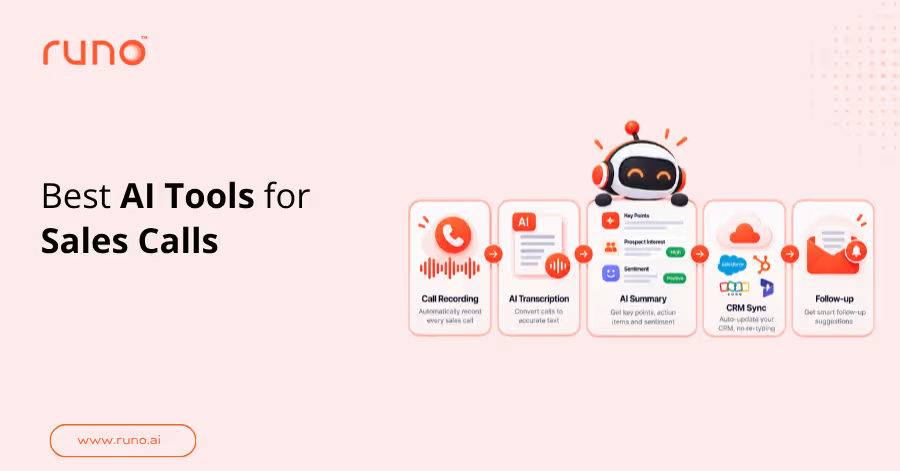
- It automatically logs and records every sales call, generates AI call summaries and sentiment scores, and feeds it all into a built-in CRM so nothing needs re-typing.
- Because Runo is the first platform to unify SIM-based and virtual number calling inside one AI-powered CRM, teams get noticeably better connect rates without losing the analytics a modern sales floor needs.
- Setup takes under 30 minutes, genuinely.
Pricing starts around $7–$10 per user, per month depending on your billing cycle, with a 10-day free trial and no credit card required.
Gong:The enterprise heavyweight
Gong is the name most people think of first in conversation intelligence, and it earns that reputation with strong deal-risk scoring, forecasting, and searchable call libraries.
- It records and analyzes calls at scale, surfaces deal risk, and tracks talk-to-listen ratios across an entire enterprise pipeline.
- It gives reps and managers a searchable call library, so any past conversation can be found again in seconds.
- Built for large revenue teams with the budget and RevOps muscle to make full use of it.
However, the price tag is the only catch. Reported figures put per-user licensing around $100–$135 a month, plus a separate platform fee that can run anywhere from $5,000 to $50,000 a year, not exactly a fit for a lean outbound team.
Chorus by ZoomInfo: Good if you're already in that ecosystem
Chorus focuses on coaching at scale, helping managers standardize what "a great call" sounds like across the team. It makes the most sense for teams already invested in that platform.
- It automatically flags competitor mentions during a call, so managers know when a deal is at risk of slipping to a rival.
- It tracks talk ratios on every call, giving managers a clear read on whether reps are talking too much or listening enough.
- It syncs tightly with ZoomInfo's contact data, which is useful if your team already relies on ZoomInfo for prospecting.
Pricing is entirely custom and quote-based, with reported figures often landing above $1,000 per user per year once bundled with other ZoomInfo modules.
Avoma: The budget-friendly option for meeting-heavy teams
Avoma is an AI meeting assistant built around recorded video meetings rather than high-volume dialing, which makes it a natural fit for B2B teams that sell mostly through scheduled Zoom or Google Meet calls instead of outbound phone calls. If that sounds like your team, it's worth a look.
- It handles meeting transcription, AI notes, and CRM auto-fill at a more approachable price.
- It also handles group and round-robin meeting scheduling, so booking a call and logging it happen in the same workflow instead of two separate tools.
- It's a solid, no-frills pick for smaller teams.
Prices are roughly $19 to $39 per user, per month, with a limited free "viewer" tier.
Clari Copilot (formerly Wingman), for live, in-the-moment coaching
Clari Copilot specializes in real-time coaching, surfacing battlecards and objection-handling prompts to reps while they're still on the call.
- It works well for teams ramping new hires quickly and wanting a manager's eye on live conversations.
- It surfaces live battlecards during the call itself, so reps get the right talking point or objection-handling script the moment they need it, not after the call is already over.
- It links conversation insights back to deal data in Clari's forecasting tools, connecting what was said on the call to how the deal is actually tracking.
It's priced around $90–$110 per user, per month, which puts it below Gong's licensing cost while still offering live, in-call coaching that most low-priced tools skip.
| Platform | Standout AI Features | Starting Price* | Free Trial | Best Fit | Ideal Team Size |
| Runo | AI call summaries, sentiment analysis, MoM notes, live dashboards, SIM + virtual dialer, built-in CRM | ~$7–$10/user/mo (billed annually) | 10 days, no card | Outbound & field teams (real estate, insurance, education, BFSI) | 5 to 5,000+ agents |
| Gong | Deal risk scoring, revenue forecasting, conversation search | ~$100–$135/user/mo + platform fee | Demo only | Enterprise SaaS revenue teams | Mid-market to enterprise |
| Chorus (ZoomInfo) | Talk-track analysis, competitor mention tracking, ZoomInfo data sync | Custom quote, often $1,000+/user/yr | 14-day demo | Teams already on ZoomInfo | Mid-market to enterprise |
| Avoma | Meeting transcription, AI notes, CRM auto-fill, scheduling | $19–$39/user/mo | Free viewer tier | Meeting-heavy B2B teams | SMB to mid-market |
| Clari Copilot (Wingman) | Live battlecards, real-time coaching, deal intelligence | ~$90–$110/user/mo | Free trial available | Teams wanting live, in-call coaching | Mid-market to enterprise |
Why Do Sales Teams Need an AI Sales Call Tool?
Sales leaders don't need convincing that AI is reshaping the sales floor; the data already makes the case for them, and it explains exactly why so many teams are adding an AI sales call tool to their stack right now.
According to Salesforce's State of Sales report, sales reps spend roughly 70% of their time on non-selling tasks such as admin work, data entry, and meeting prep, leaving little room to sell. The same report found that 83% of sales teams using AI reported revenue growth, compared to just 66% of teams that hadn't adopted it. Gartner's research tells a similar story: sellers who effectively partner with AI tools are 3.7 times more likely to meet quota than those who don't. Zoom out even further, and McKinsey estimates that generative AI could unlock between $0.8 trillion and $1.2 trillion in productivity value across global sales and marketing functions alone.
None of that means AI replaces good salespeople; it doesn't. What it does is take the busywork off their plate, so the actual selling gets the attention it deserves. That's really the whole pitch behind AI tools for sales teams right now. It’s the baseline for any team that wants to hit quota, shorten ramp time for new reps, and keep pace with buyers who are more informed and less patient than ever before.
What Separates a Genuinely Useful Tool From a Gimmick
Every vendor slaps "AI-powered" on their homepage these days. Before you sign anything, make sure the tool actually does these things:
- It records and transcribes every call automatically. No manual uploads, no "oops, forgot to hit record."
- It writes a real summary, not just a transcript dump. Action items, tone, next steps, the stuff a manager can actually use.
- It flags deals that are going sideways. Sentiment analysis should catch a frustrated prospect before your CRM does.
- It updates your CRM on its own. If reps still have to copy-paste notes, you haven't really fixed anything.
- Managers get a live view of the floor. Who's on a call, who's idle, who needs a nudge in real time, not in next week's report.
- It sets up fast. If onboarding takes a quarter, you've already lost momentum.
Run any shortlist of sales call analytics tools through that checklist and the pretenders fall away pretty quickly.
Why Runo Stands Out for Outbound and Field Sales Teams ?
Most conversation intelligence platforms assume your team sits at a desk, dials through a browser, and joins calls over VoIP. Unfortunately, that leaves a real gap for the millions of reps worldwide who sell over SIM-based mobile calls, such as real estate agents, insurance advisors, education counselors, and field sales teams who are constantly on the move. Runo was built to lead in this space.
It is one of the more complete AI tools for sales reps that doesn't just record a call and call it a day. Runo’s AI-powered sales management software scores sentiment, tracks who's talking versus listening, and reminds reps to follow up at the right time. Managers also get to watch live dashboards, see exactly who's on a call, who's fallen behind, and how the team is tracking against targets.
With Runo, SIM-based and virtual number calling work together under one AI-powered CRM. So, you can expect it to deliver SIM-level connect rates plus the analytics and compliance controls (including built-in DNC/DND checks) that larger teams need. Its sales call recording software auto-records every inbound and outbound call, on SIM or desktop, and automatically pairs it with AI-generated transcripts, minutes of meeting, and action items.
Moreover, Runo’s telecaller app bundles the dialer, CRM, and live call tracker into tool, which makes it comfortable to scale from a 5-person team to an enterprise floor with 5,000+ agents. Since it's designed to be live in under 30 minutes with no IT support required, teams start seeing value from day one instead of spending a quarter on rollout.
Try Runo free for 10 days, no credit card, no long setup. Just plug in your team and watch the dashboard fill up.
Frequently Asked Questions
How do AI sales call tools actually improve close rates?
AI tools remove the manual work of note-taking and CRM updates, flag deal risk through sentiment analysis, and give managers real-time visibility to coach reps faster. Gartner found that sellers who partner effectively with AI are 3.7 times more likely to meet quota.
Are AI tools for sales reps difficult to set up?
Not with modern platforms. Runo, for example, is designed to be fully operational in under 30 minutes. Reps simply install the app and continue calling as usual while it logs, records, and analyzes every call automatically.
Can small sales teams benefit from sales call analytics tools, or are they only for enterprises?
Small and mid-sized teams often see the fastest ROI, since they typically lack dedicated sales ops support. And tools like Runo work for teams of all sizes. So SMBs get the same AI call summaries and dashboards as larger organizations without enterprise-level complexity or cost.
Do AI sales call tools work for SIM-based or mobile calling teams, not just VoIP?
Most conversation intelligence platforms are built around VoIP and desktop dialers. Runo is a notable exception; it's the first platform to unify SIM-based and virtual number calling with an AI-powered CRM. It’s one of the few options genuinely suited to outbound field sales teams calling from mobile devices.