

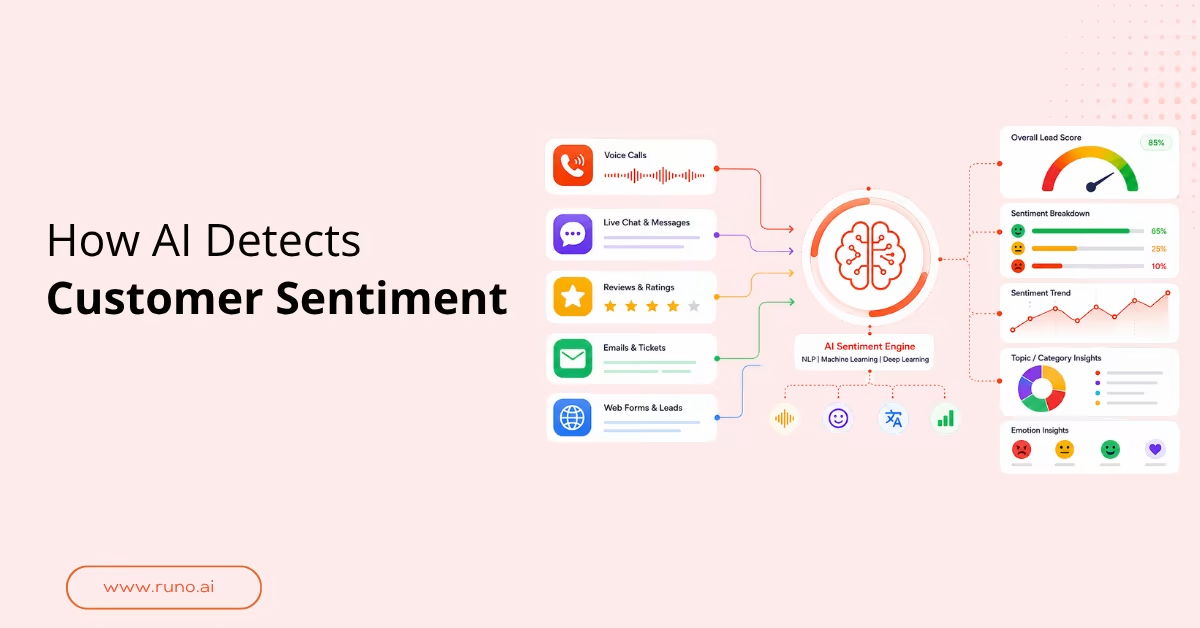
AI detects customer sentiment by converting speech or text into data, then analyzing word choice, tone, pitch, pace, and context using natural language processing and machine learning. It classifies each interaction as positive, negative, or neutral, and advanced systems detect specific emotions such as frustration or satisfaction, automatically scoring the intensity of each interaction.
Key Takeaways
- AI sentiment analysis reads both what a customer says and how they say it, including tone and pace.
- Modern systems classify emotions as positive, negative, or neutral and detect specific feelings such as frustration.
- On calls, AI scores agent and customer sentiment separately for every conversation.
- Customer sentiment analysis AI works across calls, support tickets, reviews, and survey feedback.
- Runo automatically applies sentiment analysis to every call, with no manual review required.
Every customer interaction carries emotion. A frustrated customer who stays polite, a satisfied one who sounds rushed, a confused one who says nothing is wrong. These signals predict churn, satisfaction, and revenue, but they are invisible at scale. AI sentiment analysis makes them measurable, whether the source is a call, a review, or customer feedback sentiment analysis from a survey.
This post explains how AI detects customer sentiment, what signals it reads, where businesses use it, and what it delivers.
What Is Customer Sentiment Analysis?
Customer sentiment analysis is the process of identifying and categorizing the emotions behind what a customer says or writes. It determines whether an interaction is positive, negative, or neutral, and advanced systems can detect specific emotions such as anger, confusion, relief, or delight.
The technology behind it is called natural language processing, paired with machine learning. NLP reads the language. Machine learning recognizes patterns across millions of interactions and improves accuracy over time. Together, they turn raw conversations into emotional data that a business can act on. Platforms like IBM Watson Natural Language Understanding extract sentiment, emotion, keywords, and entities from text this way.
Manual analysis cannot scale to this. A support team receiving thousands of calls, tickets, and reviews has no way to read every one and judge the emotion behind it. Customer sentiment analysis AI processes it all consistently, applying the same criteria to every interaction.
How Does AI Detect Customer Sentiment?
Understanding how AI detects customer sentiment means breaking the process into steps. Each one builds on the last.
Step 1: Capture the interaction. The system takes in the raw input, whether that is a recorded call, a live conversation, a support ticket, a review, or a survey response.
Step 2: Convert to text. For voice interactions, speech recognition converts audio to text with speaker labels. For written input, this step is already done.
Step 3: Process the language. NLP breaks the text into components, identifying words, phrases, negations, and context. It understands that “not bad” is positive, and that “great, just great,” said after a problem, may be sarcasm.
Step 4: Extract features. The system identifies signals of emotion: specific words, intensity markers, punctuation in text, and tone, pitch, and pace in voice.
Step 5: Classify sentiment. Machine learning models assign a sentiment score and category. Basic systems output positive, negative, or neutral. Advanced ones detect specific emotions and rate their intensity.
Step 6: Output and act. The result lands in a dashboard, triggers an alert on a negative interaction, or feeds into a report. On calls, this happens in real time or immediately after the call ends.
Research shows these models perform well. A 2025 study on arXiv found that an AI sentiment system reached 89.7% accuracy across large, diverse datasets, outperforming standard methods.
What Signals Does AI Analyze in a Call?
Voice interactions give AI more to work with than text, because AI sentiment analysis for calls reads both the words and how they are spoken.
In-text, the AI analyzes word choice, phrasing, negations, intensity words, and context throughout the conversation. In voice, it adds a second layer: tone, pitch, volume, pace, and pauses. A customer saying “that’s fine” in a flat, slow tone reads differently than the same words said brightly.
The most accurate AI sentiment analysis for calls combines both layers. It reads the transcript for what was said and analyzes the audio for how it was said. This dual-channel approach captures emotions that text alone misses, such as frustration masked by polite words.
On a sales or support call, the AI scores the agent and the customer separately. This matters because a call can have a positive agent and a frustrated customer at the same time, and a manager needs to see both.
Where Is Customer Sentiment Analysis Used?
Customer feedback sentiment analysis appears across every channel where customers express themselves.
Sales and support calls. AI scores the emotion of every call, flagging negative interactions for follow-up and identifying which agents consistently leave customers satisfied or frustrated.
Support tickets and chat. Sentiment analysis prioritizes tickets by emotional urgency, pushing angry or at-risk customers to the front of the queue rather than treating every ticket as equal.
Reviews and social media. Brands track sentiment across thousands of reviews and posts to spot a problem with a product or campaign before it spreads. Tools reviewed on Gartner Peer Insights handle this at scale across channels.
Surveys and feedback forms. Customer feedback sentiment analysis reads open-text survey responses at scale, turning thousands of written comments into measurable emotional trends rather than quotes a human has to read one by one. A 2025 peer-reviewed study using NLU on patient interviews found that 93.2% of identified entities carried a negative sentiment, demonstrating how precisely the technology surfaces emotional patterns in open text.
For teams handling high volumes of phone calls, the most valuable application is call sentiment analysis. Runo automatically runs sentiment analysis on every call, scoring agent and customer emotions separately as part of its AI Call Summary and Call Center Monitoring Software .
How Runo Applies Sentiment Analysis to Every Call
Runo scores the emotional tone of both the agent and the customer separately on every call, marking each as positive, neutral, or negative. The analysis runs automatically the moment a call ends, with no manual review and no separate tool to set up.
Because Runo is a SIM-based call CRM, it captures sentiment from calls made over the device’s mobile network, not just from VoIP or video meetings. The sentiment score appears alongside the AI call summary, quality score, and compliance check for each call, so a manager can see the full emotional and performance picture in one place.
Aggregated across the team, this surfaces which agents consistently leave customers positive, which calls trended negative, and where sentiment is dropping over time. Instead of guessing why a customer churned, a manager can open the call, read the transcript, and see exactly where sentiment shifted. That turns sentiment from a number into a coaching tool.
What Are the Benefits of AI Sentiment Analysis?
AI sentiment analysis delivers value that manual review cannot match at scale.
You catch problems before they escalate. Real-time sentiment detection flags a call as it trends negative, giving a supervisor the chance to step in before the customer is lost.
You coach agents with evidence. Sentiment scores show which agents consistently trigger negative reactions and which keep customers positive. AI sentiment analysis for calls turns vague coaching into specific, data-backed conversations.
You spot churn risk early. A customer whose sentiment drops across several interactions is a churn signal. Tracking sentiment over time surfaces at-risk accounts before they leave.
You measure every interaction, not a sample. Human QA reviews a fraction of conversations. AI scores all of them using consistent criteria, eliminating sampling gaps and inconsistencies across reviewers.
You see trends across the whole business. Aggregated sentiment data shows whether customer happiness is rising or falling by day, team, product, or campaign. That is data that does not exist anywhere else.
FAQs
How accurate is AI sentiment analysis?
Accuracy ranges from around 83% to 90% depending on the model, the audio or text quality, and whether the system combines speech and text analysis. A 2025 study reported 89.7% accuracy on diverse datasets. Accuracy improves with clean audio, clear speaker separation, and models trained on relevant data.
Can AI detect sentiment in real time during a call?
Yes. Modern systems process audio as the call happens, scoring sentiment live so a supervisor can intervene on a call trending negative. Other platforms score sentiment immediately after the call ends. Runo analyzes sentiment on every call and surfaces it in the dashboard right after the call.
What is the difference between sentiment analysis and emotion detection?
Sentiment analysis classifies an interaction as positive, negative, or neutral. Emotion detection goes further, identifying specific feelings like frustration, confusion, relief, or delight, and often scoring their intensity. Advanced customer sentiment analysis systems do both.
Does AI sentiment analysis work on phone calls or only text?
Both. For text like reviews and tickets, AI reads word choice and context. For phone calls, it adds tone, pitch, and pace analysis to the transcript. Combining both layers makes customer sentiment analysis AI more accurate on voice than text alone.
Book a demo with Runo to see automatic sentiment analysis on every call across a live sales team.