

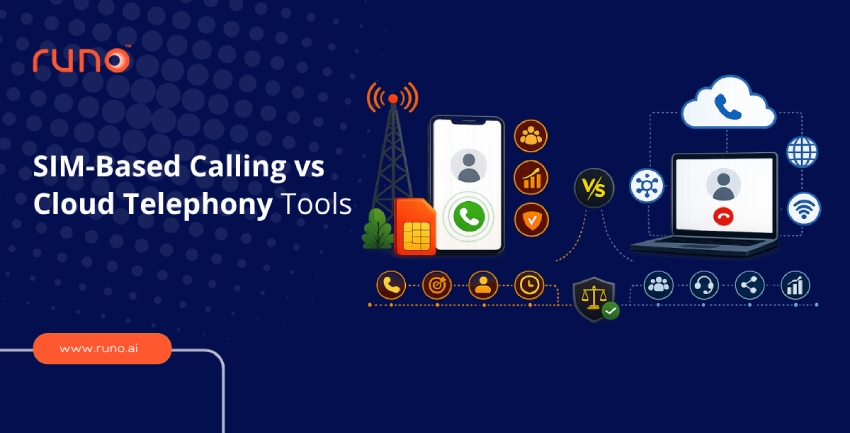
SIM-based calling routes calls through the device’s mobile SIM card using the cellular network. Cloud telephony routes calls over the internet using VoIP. The core difference for sales teams is the connect rate: SIM-based calling displays a recognisable local mobile number, while cloud telephony often shows unknown or flagged caller IDs. This directly affects how many prospects pick up.
Key Takeaways
- SIM-based calling uses the mobile network, producing a 78% connect rate on Runo versus the sub-30% common with VoIP dialers.
- Cloud telephony routes calls over the internet and works best for inbound contact centers, multi-channel support, and distributed teams.
- In India, 83% of total voice connections are mobile wireless, according to the FCC’s 2025 Voice Telephone Services Report. People answer mobile numbers. They ignore unknown VoIP numbers.
- TRAI regulations require outbound calls between 9 AM and 9 PM, DND list scrubbing, and caller ID transparency. Both SIM-based and cloud systems must comply.
According to the FCC’s 2025 Voice Telephone Services Report, mobile wireless now accounts for more than 83% of all voice service connections in the United States, with wired lines declining at a 17.8% compound annual growth rate. The trend is global. People use mobile phones. They answer calls from mobile numbers. That single fact shapes everything in this comparison.
The call center AI market will reach $7.08 billion by 2030 at a 23.8% CAGR, according to Grand View Research. AI features are increasingly available on both SIM-based and cloud platforms, but they only produce value when the underlying calls actually connect.
What Is SIM-Based Calling?
SIM-based calling routes calls through the SIM card installed in a mobile device, using the cellular network rather than the internet. The call travels through the same infrastructure as a regular phone call. The recipient sees a real, local mobile number on their screen.
For outbound sales teams, this has one practical consequence that outweighs everything else: people pick up. A call from a mobile number looks like a call from a person, not a call from a call center.
Here is an example. A telecalling team in Mumbai runs outbound campaigns to small business owners across Maharashtra. When they call from a VoIP dialer, the recipient sees an unknown number or a number flagged as “Spam Likely.” They do not answer. When the same team calls from Runo’s SIM-based platform, the recipient sees a local mobile number. They pick up. The team has the same script, the same agents, and the same leads. The difference is the connect rate.
Runo achieves a 78% call connect rate using SIM-based calling. VoIP dialers typically sit below 30% for cold outbound.
What Is Cloud Telephony?
Cloud telephony routes calls over the internet using VoIP (Voice over Internet Protocol). There is no SIM card, no cellular network, and no physical hardware at the agent’s end. Calls are made through a browser, desktop app, or softphone, and managed from a cloud-based dashboard.
The cloud-based contact center market was valued at $32.65 billion in 2025, growing at a 23.6% CAGR to reach $116.33 billion by 2031, according to Mordor Intelligence. Cloud telephony is a large, established category. It works well for inbound contact centers, support teams, and businesses that need multi-channel routing across voice, chat, and email from a single platform.
Where it struggles is outbound calling to mobile numbers, especially in markets like India. VoIP numbers often display as unknown, out-of-area, or spam-flagged on the recipient’s phone. That kills the connect rate before the agent says a word.
How Do SIM-Based Calling and Cloud Telephony Compare?
When evaluating cloud telephony vs SIM calling, the differences that matter most for a sales or telecalling team are in this table.
| Factor | SIM-Based Calling | Cloud Telephony |
| Call routing | Cellular network via device SIM | Internet via VoIP |
| Caller ID display | Local mobile number | Often unknown, virtual, or flagged |
| Connect rate (outbound) | ~78% on Runo | Typically under 30% for cold outbound |
| Internet dependency | None for calling | Fully dependent |
| Best for | Outbound sales, telecalling, field teams | Inbound support, multi-channel contact centers |
| Agent device | Mobile phone (Android/iOS) | Browser, desktop app, or softphone |
| Call quality in low-bandwidth areas | Cellular quality, independent of WiFi | Degrades with poor internet |
| AI analysis available | Yes (Runo: scoring, sentiment, summaries) | Yes (on most enterprise platforms) |
| CRM integration | Yes | Yes |
| Scalability | Add agents with any SIM-enabled device | Add agents with any internet-connected device |
Where Does Each Model Work Best?
When SIM-based calling is the right choice
High-volume outbound sales. If your team makes 50 or more calls per agent per day and connect rate directly affects revenue, SIM-based calling gives you the highest possible pickup rate. This is the use case Runo is built for.
Here is a practical example. A real estate company has 30 agents following up on website leads. Each agent makes 80 calls a day. On a VoIP dialer with a 25% connect rate, each agent reaches 20 live conversations. On Runo’s SIM-based platform with a 78% connect rate, each agent reaches 62 live conversations. Across 30 agents, that is 1,260 more conversations per day from the same team size and the same lead list.
Field sales and delivery operations. Agents working in the field call from their phones, often in areas with unreliable WiFi. SIM-based calling does not depend on internet connectivity. The call works wherever the cellular network works.
India-specific outbound teams. In India, TRAI regulations require registered telemarketers to use designated 140-series numbers for promotional calls. But for relationship-based and transactional calls (follow-ups, appointment confirmations, service calls), calling from a recognisable mobile number dramatically improves answer rates. Runo’s auto dialer and lead management system handle auto-assignment and follow-up scheduling while every call routes through the SIM.
When cloud telephony is the right choice
Inbound contact centers. If your team receives more calls than it makes, cloud telephony gives you IVR trees, skill-based routing, queue management, and call distribution across a large agent pool. These are features designed for inbound volume.
Multi-channel support. If your team handles voice, chat, email, and social from one platform, cloud telephony is the native infrastructure for that. SIM-based calling is voice-focused.
Distributed or remote teams on desktops. If your agents work from laptops or desktop machines and do not use mobile phones, a browser-based softphone is the practical option. SIM-based calling requires a mobile device.
What Should Sales Teams Check Before Choosing?
Use this checklist to match the right model to your team’s actual workflow.
- Do your agents make calls from mobile phones? → SIM-based
- Do your agents work from a browser or desktop app? → Cloud telephony
- Is outbound cold or warm calling your primary activity? → SIM-based
- Is inbound call routing your primary activity? → Cloud telephony
- Does your connect rate directly affect revenue? → SIM-based
- Do you need multi-channel support (voice, chat, email) in one tool? → Cloud telephony
- Do your agents work in areas with unreliable internet? → SIM-based
- Do you need IVR, queue management, and skill-based routing? → Cloud telephony
If you checked three or more boxes on the SIM-based side, SIM-based calling for sales teams is the stronger fit and will deliver a higher connect rate on outbound campaigns. If you checked three or more on the cloud side, cloud telephony serves your use case better.
Can You Use Both?
Yes. Many teams run a hybrid setup, which is often the best resolution to the cloud telephony vs SIM calling question. Runo itself supports both SIM-based calling and cloud telephony in one platform. An outbound sales team can use SIM-based calling for prospecting and follow-ups during the day, while an inbound support team uses cloud-based routing for customer calls.
The key is matching the call type to the right infrastructure. Outbound calls where the connect rate matters most should route through SIM. Inbound calls where routing and queue management matter most should route through cloud. Runo’s call center monitoring software gives managers a single real-time dashboard across both.
What About AI on SIM-Based Calls?
One common assumption is that AI call analysis only works on VoIP calls. That is not true. SIM-based calling for sales teams on Runo gets the same AI treatment as any cloud call. McKinsey reports that AI in contact centers cuts average handling time and cost per call while improving satisfaction, and those gains apply regardless of how the call was routed.
Every call gets a quality score out of 100. Sentiment is scored separately for the agent and the customer. Compliance parameters check whether the agent introduced themselves, handled objections, and closed the call properly, with each result linked to the specific transcript line used as evidence. The AI Call Summary writes a paragraph summary of the call, extracts action items, and assigns each to the right person. Managers can build their own evaluation criteria using the custom scorecard builder and have the AI apply those rules to every future call.
The full transcript is searchable by keyword. A manager looking for how a rep handled pricing can search “pricing” and jump to the exact moment rather than replaying the recording. All of this runs on SIM-based calls the same way it would on a VoIP call, which is what makes Runo different from cloud telephony tools that offer AI but only on internet-routed calls.
Book a demo with Runo to see SIM-based calling and AI call analysis working together on a live sales team.
FAQs
What is the main difference between SIM-based calling and cloud telephony?
The core difference in the SIM-based calling vs cloud telephony comparison is how calls route. SIM-based calling uses the cellular network via a device’s SIM card. Cloud telephony uses the internet via VoIP. The practical result is caller ID: SIM-based calls show a local mobile number, which gets answered. VoIP calls often show as unknown or spam-flagged.
Which is better for outbound sales teams in India?
SIM-based calling for sales teams in India delivers significantly higher connect rates. Runo’s SIM-based platform reaches a 78% connect rate versus sub-30% on VoIP. For teams where every connected call is a revenue opportunity, this gap determines daily output.
Can AI call analysis work on SIM-based calls?
Yes. Runo applies AI call summaries, sentiment analysis, quality scoring, and compliance checks to every SIM-based call automatically. The cloud telephony vs SIM calling distinction does not apply to AI features on Runo because both call types get the same analysis.
Is cloud telephony cheaper than SIM-based calling?
Cloud telephony often has lower per-minute costs. However, cost per connected conversation is a better metric for outbound teams. If 70% of VoIP calls never connect, the cost per actual conversation is much higher than the per-minute rate suggests. In any SIM-based calling vs cloud telephony evaluation for outbound, measure cost per live conversation, not cost per dial.
Do both models comply with TRAI regulations?
Both must comply. TRAI requires outbound promotional calls between 9 AM and 9 PM only, DND list scrubbing, caller ID transparency, and call logs retained for audit. Runo includes built-in TRAI and GDPR compliance on its SIM-based calling platform.