

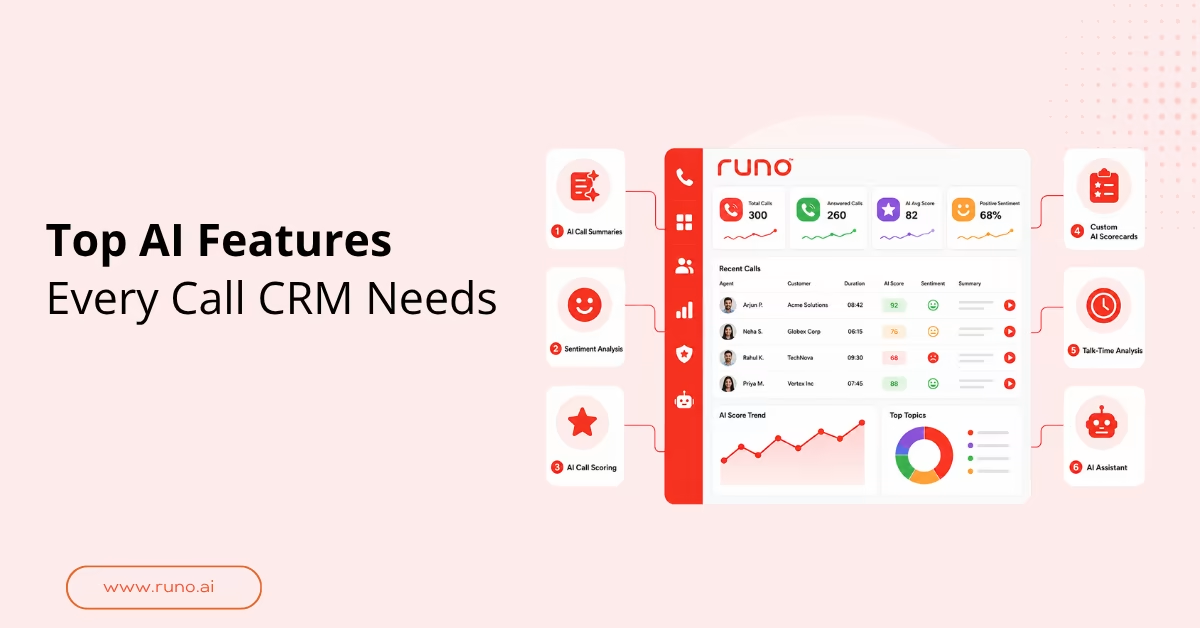
The top AI features every call CRM needs are automatic call summaries, sentiment analysis, AI call scoring, call transcription, compliance checks, custom AI scorecards, talk-time analysis, and an AI assistant. Together, these features let managers evaluate every call automatically instead of reviewing a small sample manually.
Key Takeaways
- AI call summaries remove manual note-taking and capture every call’s outcome automatically.
- Sentiment analysis scores both agent and customer emotion on every call, not a sample.
- AI call scoring grades each call against fixed criteria with no manual review.
- Custom AI scorecards let you define your own evaluation rules and apply them automatically.
- A call CRM without these AI features is a recorder, not an analysis tool.
AI moved from optional to essential in call CRMs because managers cannot review every call by hand. A team of 20 agents making 300 calls a day produces over 12 hours of audio. No supervisor can listen to a fraction of that while managing the floor. The right AI call management CRM features process all of it automatically and surface what needs attention.
This post covers the eight AI call management CRM features that separate a basic dialer from a real AI call CRM, what each does, and how they connect into one workflow.
Why Do Call CRMs Need AI Now?
Manual quality assurance reviews less than 5% of total calls. A manager listening to four or five calls per agent per week judges performance on a tiny, often unrepresentative sample. The other 95% of calls, where most problems and opportunities sit, never get seen.
AI changes the math by scoring every call against the same criteria. The adoption numbers reflect how quickly this became standard. According to Calabrio’s State of the Contact Center 2025 survey of 437 contact center managers, 98% of contact centers now use AI in some form . A 2024 Gartner survey found that 85% of customer service leaders planned to explore or pilot conversational generative AI in 2025.
The financial case is just as direct. McKinsey reports that AI in contact centers cuts average handling time and cost per call while improving customer satisfaction. Its research on gen AI in customer care documents transformational gains in agent efficiency from these tools.
What Are the Top AI Features Every Call CRM Needs?
These are the eight AI features in call CRM platforms that matter most, and the call CRM AI features to treat as non-negotiable. Use this as a checklist when evaluating any tool.
1. AI Call Summaries
AI call summaries generate a written record of every call automatically, in paragraph form. A good summary captures what was discussed, what the customer shared about their situation, and what was agreed at the end.
This removes the most common reason CRM data is incomplete: agents skipping notes to move to the next call. When the summary is automatic, the record is always there. Managers read a 30-second summary instead of replaying a five-minute call to understand what happened.
2.AI Sentiment Analysis
Sentiment analysis reads the emotional tone of the conversation and scores the agent and the customer separately as positive, neutral, or negative. It tracks this across the full call, not just at one point.
This catches what outcome metrics miss. A call can be short, technically resolved, and still leave the customer annoyed. Aggregated across a team, sentiment shows which agents trigger negative reactions and which call types create the most friction.
3.AI Call Scoring
AI call scoring grades every call out of 100 against a fixed set of criteria. The score combines sentiment, talk-time balance, compliance, and call conduct into a single number that is comparable across agents and across days.
The value is consistency. A human reviewer scores differently on a Monday than a Friday, and differently from another reviewer. The AI applies identical criteria to every call, so a score of 72 means the same thing for every agent. Consistent scoring is one of the best AI features for call management CRM platforms, because it makes performance rankings defensible rather than subjective.
4. Automatic Call Transcription
Transcription converts every call into searchable, timestamped text with each line attributed to the correct speaker. A manager searching for “pricing” or “cancellation” jumps straight to the moment it was said.
This is the foundation the other AI features depend on. Summaries, scoring, sentiment, and compliance checks all read the transcript first. For managers, it removes the slowest part of call auditing: scrubbing through audio to find one relevant section.
5. Compliance Parameter Checks
Compliance checks verify whether the agent followed required steps on each call: introducing themselves, verifying the customer, handling objections, closing properly, and avoiding prohibited language. Each result is marked pass, fail, or not applicable, and links to the exact transcript line used as evidence.
For teams in regulated sectors like finance, insurance, or healthcare, this replaces manual compliance auditing. Instead of a QA analyst spot-checking calls and hoping to catch violations, every call is checked automatically and flagged the moment a required step is missed.
6. Custom AI Scorecards
Custom scorecards let managers write their own evaluation questions, define what counts as a pass or fail, set the score weight for each, and have the AI apply those rules to every future call.
This matters because no two businesses sell or support the same way. A default scorecard built for a generic call center will not measure what matters for your product or customer type. With custom scorecards, a manager can add a parameter like “Did the agent confirm the renewal date?” and every call from that point is evaluated against it.
7. Talk-Time and Filler Word Analysis
This feature measures how much of the call the agent spoke versus the customer, and counts filler words like “um,” “okay,” and “basically” per call.
Both signals are hard to spot manually but easy to coach once measured. An agent speaking 80% of a discovery call is talking, not listening, and likely missing buying signals. An agent using 40 filler words in three minutes sounds less confident. The data turns vague feedback like “be more concise” into specific coaching.
8. AI Chat Assistant
An AI assistant lets managers ask questions about their calls in plain language or trigger actions directly. Instead of building a report, a manager can ask which agents had the lowest sentiment scores this week, or schedule a follow-up. It makes the insights from the other seven call CRM AI features accessible without navigating dashboards or exports.
Basic vs Advanced Call CRMs: Which AI Features Separate Them?
Many call CRMs record calls and stop there. The table below shows which AI call management CRM features separate a basic dialer from a genuine AI call CRM.
| AI Feature | Basic Call CRM | AI Call CRM |
| Call recording | Yes | Yes |
| Automatic transcription | No | Yes |
| AI call summaries | No | Yes |
| Sentiment analysis | No | Yes |
| AI call scoring | No | Yes |
| Compliance checks | Manual | Automatic |
| Custom scorecards | No | Yes |
| Filler word and talk-time analysis | No | Yes |
A tool that only records and logs calls cannot deliver the best AI features for call management CRM evaluation. It gives you a library of recordings no one has time to listen to. Metrigy research indicates that contact centers without AI need significantly more agents to match the output of AI-equipped teams.
How Do These AI Features Work Together?
The call is recorded, then transcribed with speaker labels. The AI reads that transcript and writes a summary. It scores sentiment for the agent and the customer, checks each compliance parameter, and assigns an overall quality score.
It measures talk-time balance and counts filler words. Every output lands in one dashboard the moment the call ends, and the assistant lets a manager query all of it in plain language. These AI features in call CRM platforms are only useful when they run together like this.
The outcome is a complete, scored record of every call without a manager listening to any of them. That is the practical purpose of the top AI features every call CRM needs : converting raw audio into structured data a manager can act on the same day.
Runo is a SIM-based call CRM that includes all eight of these features natively. AI Call Summary writes summaries after every call. The Sales Call Recording Software captures and transcribes calls made through the device’s SIM. The Call Center Monitoring Software surfaces scores and sentiment in real time, and the custom scorecard builder lets managers define evaluation criteria that apply automatically to every call.
FAQs
Do AI call CRM features work on SIM-based calls or only VoIP?
Most AI call CRMs only support VoIP and web-based calls. Runo is built for SIM-based calling and applies the same AI features in call CRM workflows, including transcription, sentiment scoring, and compliance checks, to every call made through the device’s mobile network.
How accurate are AI call summaries and scoring?
Accuracy depends on audio quality and speaker separation. Modern systems with clean recordings and speaker diarization produce reliable summaries and scores. Consistency matters more than perfection here, since every call is judged against the same criteria rather than a reviewer’s shifting judgment.
Can you customise what the AI evaluates on each call?
Yes, on platforms that offer custom scorecards. Managers write their own evaluation questions, define pass and fail conditions, set score weights, and the AI applies those rules to every future call. This is one of the most useful call CRM AI features for teams with specific scripts or compliance requirements.
Do AI call CRM features replace human QA teams?
No. They handle the volume humans cannot, scoring every call automatically. Human QA teams then focus on the flagged calls and the coaching conversations. The best AI features for call management CRM platforms do the screening so people can spend their time on judgment.
Book a demo with Runo to see all the AI features every call CRM needs in one platform.