


Arjun's first morning on a Hyderabad sales floor began with a printed script and a list of 80 phone numbers. By 11 a.m., he had made 23 calls. Most ended before he could finish his opening sentence.
He wasn't short of words. He simply didn't know what to do when a prospect interrupted, asked an unexpected question or showed little interest.
That evening, his team lead, Kavita, listened to a few recordings. The script wasn't the problem, she told him, but the way he was using it was.
Arjun had memorized every line but forgotten that the person on the other end was part of the conversation.
The next morning, Kavita asked him to put the script down and focus on three things: understand why the customer might be interested, ask the right questions and know what to do next.
His calls gradually changed. He stopped rushing through introductions, started listening to customer responses and became more comfortable handling objections.
Arjun and Kavita are fictional composite characters, but their experience reflects a common challenge for sales teams. A script can prepare you for a conversation, but it cannot predict every response.
This guide covers 17 telecalling scripts in English for different sales situations, from cold calling and lead qualification to follow-ups, renewals and industry-specific enquiries. Each example explains when to use it, how the conversation can unfold and what the next step should be.
What is a Telecalling Script?
A telecalling script is a written guide that outlines what a caller should say during a phone conversation. It typically includes an opening, the reason for calling, relevant questions, responses to common objections and a closing statement.
A good script provides structure without restricting the conversation. Rather than reading every line word for word, telecallers use it to stay focused, communicate clearly and respond to customer needs.
Sales representatives, telecallers and lead generation teams use scripts to maintain consistency across customer interactions. They are equally useful for teams handling product enquiries, appointment scheduling, renewals and customer feedback.
Consider Arjun's first introduction:
"Hello sir, I am calling to tell you about our amazing product."
It gave the prospect little reason to continue listening.
Kavita replaced it with a simple introduction, the company's name and a permission-based opening. The product hadn't changed. The approach had.
A good telecalling script generally includes five components:
| Component | Purpose | Example |
| Opening | Introduce yourself & respect the prospect’s time | “This is Arjun from XYZ Software. Do you have 30 seconds?” |
| Reason of calling | Establish why you’re reaching out | “I speak with distributors who manage customer orders over WhatsApp.” |
| Discovery question | Understand the prospect’s situation | “How do you currently track customer follow-ups?” |
| Value statement | Connect your offering to their requirements | “We help teams manage customer calls & follow-ups in one place.” |
| Next step | Agree on what happens after the call | “May I send you an overview & call you on Thursday?” |
Objection handling can happen at any stage. The important thing is to acknowledge the concern and respond without losing sight of the conversation's purpose.
17 Best Telecalling Scripts in English for Different Scenarios
Not every prospect picks up the phone with the same expectations. Someone hearing from your business for the first time needs context, while someone who has requested a demo may already be considering your offering.
The script should reflect that difference.
Also before getting started, remember that English doesn't have to be the only language used during a call. Many Indian customers are comfortable switching between English, Hindi and regional languages. Ask which language they prefer, and adapt your approach accordingly.
The following scripts cover different calling objectives and stages of the customer journey.
| Telecalling Script | When to Use it | Primary Objective |
| Cold Calling | Prospects unfamiliar with your business | Start a conversation |
| Warm Lead Calling | Website and advertising enquiries | Understand interest |
| Follow-Up Calling | Prospects who received a quotation or demo | Address pending concerns |
| Product Introduction | Introducing an unfamiliar offering | Generate interest |
| Lead Qualification | Early-stage prospects | Understand requirements |
| Appointment Setting | Interested prospects | Schedule a meeting |
| Lead Conversion | Prospects close to making a decision | Move towards conversion |
| Re-Engagement | Inactive or unresponsive leads | Restart the conversation |
| Missed Call Follow-Up | Missed inbound enquiries | Reconnect with prospects |
| Customer Feedback | Existing customers | Understand their experience |
| Renewal & Upselling | Existing customers | Encourage renewal or upgrades |
| Referral Request | Satisfied customers | Generate referrals |
| Real Estate | Property enquiries | Schedule site visits |
| Insurance | Insurance enquiries | Understand coverage needs |
| Education | Student and parent enquiries | Initiate a service discussion |
| Banking & Financial Services | Eligible customer enquiries | Initiate a service discussion |
| SaaS Product Demo | Business prospects | Schedule a demonstration |
Cold Calling Script
A cold call begins without an established relationship. The prospect may not recognize your company or understand why you're contacting them.
That makes the opening particularly important. Instead of launching into a pitch, introduce yourself, explain why you're calling and ask a question that gives the prospect a reason to engage.
When to use: Reaching out to prospects who have not previously interacted with your business.
Sample cold calling script:
Caller:
Good morning, Mr. Shah. This is Arjun from XYZ Software in Hyderabad. Do you have 30 seconds?
Prospect:
Go ahead.
Caller:
Thank you. I speak with distributors in Surat who manage customer orders over phone and WhatsApp. Some of them find it difficult to keep track of follow-ups when their teams get busy. Does that happen with you?
Prospect:
Sometimes, yes.
Caller:
I understand. We help businesses keep customer calls and follow-ups organised in one place. Would you be open to receiving a short overview on WhatsApp? I can also call you on Thursday if you'd like to discuss it further.
Next step:
Send the requested information and agree on a specific follow-up time.
For more guidance on approaching unfamiliar prospects, explore our guide to cold calling techniques .
Warm Lead Calling Script
Unlike cold prospects, warm leads have already shown some interest in your offering. They may have filled out a website form, downloaded a resource or enquired about your product.
The conversation should build on that interaction rather than start from scratch. Find out what prompted their enquiry and use that information to guide the discussion.
When to use: Contacting prospects who have recently enquired about your product or service.
Sample warm lead calling script:
Caller:
Hello, Ms. Iyer. This is Neha from ABC Interiors. You enquired about modular kitchens through our website yesterday. Is this a good time to talk?
Prospect:
Yes, tell me.
Caller:
Thank you. I wanted to understand what you're looking for. Is your flat ready, or are you still waiting for possession?
Prospect:
Possession is in two months.
Caller:
That helps. We can arrange a design consultation and show you a few layouts based on your space. Would Saturday morning or afternoon work better for a visit?
Next step:
Schedule a consultation or visit based on the prospect's requirements.
Follow-Up Calling Script
A prospect who has received a quotation or product demonstration may need additional information before making a decision.
The challenge is knowing what is holding them back. Instead of asking whether they've made up their mind, refer to the previous interaction and invite them to share their concerns.
When to use: Following up after sending quotations, product details or proposals.
Sample follow-up calling script:
Caller:
Hello, Mr. Reddy. This is Amit from ABC Packaging. We spoke on Monday, and I had shared the quotation for 5,000 corrugated boxes. Did you get a chance to review it?
Prospect:
Yes, I did.
Caller:
Great. Was there anything you'd like me to clarify, perhaps the pricing or delivery schedule?
Prospect:
Your price is slightly higher than another supplier.
Caller:
I understand. Would you be comfortable sharing the specifications they quoted? I can help you compare both options so you have a clearer picture before deciding.
Next step:
Address the pricing concern and schedule another discussion if required.
Cold calls, warm calls and follow-ups may share the same basic structure, but their opening statements and objectives are different.
| Call Type | Opening Focus | Primary Goal |
| Cold calling | Establish relevance | Secure a small next step |
| Warm calling | Reference the previous enquiry | Understand the interest and schedule a meeting |
| Follow-up calling | Revisit the previous discussion | Identify and resolve pending concerns |
Product or Service Introduction Script
Introducing an unfamiliar product can be challenging, especially when the prospect doesn't immediately understand its relevance.
A long list of features rarely helps. Start with a problem the customer may recognize, explain how your offering addresses it and suggest a simple next step.
When to use: Introducing a new product or service to prospects who may not be familiar with your offering.
Sample product introduction script:
Caller:
Hello, Mr. Nair. This is Pooja from XYZ INFO. I'll keep this brief. We work with HR managers at manufacturing companies who often find attendance tracking and salary calculations time-consuming. Is that something your team deals with?
Prospect:
Yes, especially towards the end of the month.
Caller:
That's exactly the kind of challenge we help address. Our payroll solution brings attendance information into the salary preparation process, reducing manual work. Would you be open to a ten-minute demonstration on Wednesday?
Next step:
Schedule a short product demonstration.
Lead Qualification Calling Script
Not every enquiry is ready to become a customer. Some prospects are exploring options, while others have a defined requirement and are actively evaluating solutions.
Lead qualification helps sales teams understand where a prospect stands before investing time in a detailed pitch.
When to use: Contacting prospects who have shown interest but have not shared enough information about their requirements.
Sample lead qualification script:
Caller:
Dr. Menon, thank you for taking my call. This is Sana from ABC Digital. To suggest something relevant, may I ask you a few questions about your requirements?
Prospect:
Sure.
Caller:
What are you hoping to improve about your clinic's online presence right now?
Prospect:
We want to attract more patients through digital channels.
Caller:
Understood. Have you tried any promotional activities before? How did those work out?
Prospect:
We tried social media advertising, but the results weren't consistent.
Caller:
I see. To make sure we recommend something within your expectations, have you set aside a monthly budget range?
Prospect:
Around ₹30,000.
Caller:
Thank you. And when would you ideally like to get started? Would you be making the decision yourself, or should we include someone else in the next discussion?
Next step:
Prepare a relevant proposal based on the prospect's requirements, budget and timeline.
Appointment Setting Script
Sometimes, the prospect is interested but isn't ready to discuss everything over the phone. In such cases, the objective is simply to secure a meeting.
Offering two specific time slots makes scheduling easier than asking an open-ended question.
When to use: Contacting prospects who have expressed interest in a meeting, consultation or site visit.
Sample appointment setting script:
Caller:
Hello, Mr. Kapoor. This is Rohit from ABC Solar. You recently enquired about rooftop solar for your factory in Jaipur. The next step would be a site survey, which takes around 40 minutes. Would Tuesday at 11 a.m. or Wednesday at 4 p.m. work for you?
Prospect:
Wednesday is better.
Caller:
Perfect. I'll send you a confirmation on WhatsApp along with our engineer's contact details. Could you also share the factory's location pin?
Next step:
Confirm the appointment, share the relevant details and schedule a reminder.
Lead Conversion Calling Script
A prospect who has attended a demonstration or received a proposal may already understand your product. What they need now is clarity on the final decision.
Instead of repeating the original pitch, identify what is preventing them from moving forward.
When to use: Following up with interested prospects who are close to making a purchase decision.
Sample lead conversion script:
Caller:
Hello, Mr. Gupta. We spoke on Tuesday after the product demonstration. I wanted to check whether you had a chance to discuss it with your team. Is there anything still holding you back from moving forward?
Prospect:
My accountant isn't entirely convinced.
Caller:
That's understandable. Since she'll also be involved in the process, would it help if we arranged a short session to address her questions directly?
Prospect:
That might help.
Caller:
Great. I'll coordinate a suitable time and make sure we cover the points she's concerned about.
Next step:
Arrange a discussion with the relevant decision-makers and address outstanding concerns.
Re-Engagement Calling Script
Some leads go quiet after an initial discussion. Their priorities may have changed, the timing may not be right or they may simply have stopped considering the purchase.
A re-engagement call should reopen the conversation without making the prospect feel pressured.
When to use: Reconnecting with leads who have not responded or progressed for 45–90 days.
Sample re-engagement calling script:
Caller:
Hello, Ms. Fernandes. This is Karthik from LearnBridge. We spoke in August about training programmes for your sales team. I wanted to check whether that's still something you're considering.
Prospect:
We had to put it on hold during the festive season.
Caller:
I understand. Would it make sense for me to reconnect in the second week of November, once things settle down?
Prospect:
Yes, that works.
Next step:
Schedule a callback for the agreed date or close the lead if the requirement is no longer relevant.
Missed Call Follow-Up Script
A missed inbound call could represent a new enquiry, a service request or an existing customer looking for assistance.
When a business calls back, the first priority is to acknowledge the missed connection and understand why the customer reached out.
When to use: Following up on missed calls from potential or existing customers.
Sample missed call follow-up script:
Caller:
Hello, this is Imran from XYZ Tyres. You called us about 15 minutes ago, but we couldn't answer. Sorry about that. How can I help?
Prospect:
I wanted to know the price for a set of four tyres for my Creta.
Caller:
Certainly. Could you tell me the tyre size mentioned on the sidewall? I'll check the available options and share the details with you.
Next step:
Share the relevant pricing information and arrange a fitting appointment if required.
Customer Feedback Calling Script
The conversation doesn't end once a customer makes a purchase. Their experience after the transaction can influence whether they return, renew or recommend your business.
A feedback call helps identify concerns early and gives customers an opportunity to share their experience.
When to use: Following up after a product delivery, installation or service interaction.
Sample customer feedback calling script:
Caller:
Hello, Mrs. Pillai. This is Deepa from ABC Enterprise. Our technician installed your water purifier last Monday. I wanted to check how it's working for you.
Prospect:
It's fine, although the water pressure seems a little low.
Caller:
Thank you for letting us know. I'll arrange for our technician to look into it. Would tomorrow work for a visit?
Prospect:
Yes.
Caller:
Perfect. I'll confirm the appointment shortly. Also, how would you rate your overall installation experience so far, on a scale of one to ten?
Next step:
Record the feedback, arrange service assistance if necessary and track issue resolution.
Renewal or Upselling Calling Script
Renewal and upselling conversations work best when they're based on how customers currently use a product or service.
Rather than immediately pitching an upgrade, understand their experience and identify whether a different plan would address an actual requirement.
When to use: Contacting existing customers before their subscription or service plan expires.
Sample renewal calling script:
Caller:
Hello, Mr. D'Souza. This is Vikram from ABCHosting. Your annual plan is due for renewal on the 22nd. How has the website been performing?
Prospect:
It's been good, although we noticed some slowdowns during our recent sale.
Caller:
I understand. We have a higher plan that offers more resources for periods of increased traffic. Would you like me to share both renewal options so you can compare them?
Prospect:
Yes, please.
Next step:
Share the renewal and upgrade options, then follow up before the expiry date.
Referral Request Calling Script
Satisfied customers can become a valuable source of new business. However, asking for referrals works best when the customer has already expressed satisfaction with your product or service.
Keep the request simple and make it easy for them to introduce someone.
When to use: Contacting customers who have recently shared positive feedback.
Sample referral request script:
Caller:
Hello, Mr. Banerjee. This is Anjali from ABCMate. I'm glad to hear that your filing process went smoothly. Do you happen to know any other business owners who might need help managing their GST filings?
Prospect:
My cousin runs a garment shop.
Caller:
That's great. If you're comfortable, I can send you a short message that you can forward to him. I won't contact him unless he's interested.
Next step:
Share a forwardable introduction and follow up only with the prospect's permission.
5 Industry-Specific Telecalling Scripts
The objective of a call changes depending on the industry. A real estate salesperson may be trying to schedule a site visit, while an insurance representative needs to understand a customer's coverage requirements before discussing a policy.
The following examples show how to adapt a calling approach to different industries.
Real Estate Telecalling Script
Property buyers often compare multiple projects before making a decision. A real estate telecaller needs to understand their budget, preferred location and purchase timeline before suggesting a property.
When to use: Contacting property portal enquiries, website leads and prospective buyers.
Sample real estate telecalling script:
Caller:
Good evening, Mr. Joshi. This is Mayuri from ABCHomes in Pune. You recently enquired about our 2 BHK apartments in Hinjewadi. Is this a good time to talk?
Prospect:
Yes.
Caller:
Great. Are you planning to purchase a property within the next few months, or are you still comparing different locations?
Prospect:
Ideally, within six months.
Caller:
Understood. What budget range are you considering? Even an approximate figure will help me suggest suitable options.
Prospect:
Around ₹80 lakhs.
Caller:
That helps. Would you be interested in visiting the property this weekend? I can arrange a site visit on Saturday at 11 a.m. or Sunday at 4 p.m.
Next step:
Schedule a site visit and share the relevant property details.
Insurance Telecalling Script
Insurance conversations require a needs-based approach. Instead of starting with premiums or policy benefits, understand the customer's circumstances and explain the coverage, exclusions and applicable terms clearly.
When to use: Contacting individuals who have submitted an insurance enquiry or consented to receiving information.
Sample insurance telecalling script:
Caller:
Hello, Ms. Rao. This is Farhan from SecureLife Advisors. You recently enquired about term insurance. Is this a good time to talk?
Prospect:
Yes, briefly.
Caller:
Thank you. Before discussing any plans, I'd like to understand your requirements. Do you currently have any dependents who rely on your income?
Prospect:
Yes, my parents and younger sister.
Caller:
Understood. In that case, we should first look at the coverage you may need. I can explain a couple of suitable options, including their premiums, benefits and exclusions. Would tomorrow evening work for a detailed discussion?
Next step:
Schedule a needs assessment and share relevant policy information with clear disclosures.
Education and Course Enquiry Script
Education enquiries often involve more than one decision-maker. Students may be interested in the course content and career opportunities, while parents may want to understand the fees, placement support and overall value.
The caller should identify these priorities before recommending a program.
When to use: Following up on admission enquiries, course registrations and counselling requests.
Sample education telecalling script:
Caller:
Hello, this is Divya from ABCStar Institute. You recently enquired about our data analytics programme. Am I speaking with the student or a parent?
Prospect:
I'm the student's father.
Caller:
Thank you, sir. What is your son hoping to pursue after completing the course?
Prospect:
He wants to get a job in a good company.
Caller:
That's helpful. I'd like to arrange a counselling session where we can explain the syllabus, placement support and fee structure, including any available instalment options. Would Saturday morning work for both of you?
Next step:
Schedule a counselling session with the student and parent.
Banking and Financial Services Telecalling Script
Banking and financial services calls require particular attention to customer identity, consent and information security.
The caller should clearly state the purpose of the conversation, follow the organisation's approved verification process and use authorised communication channels.
When to use: Contacting eligible customers for relevant banking or financial service enquiries, in accordance with applicable consent and communication requirements.
Sample banking telecalling script:
Caller:
Good morning. May I confirm that I am speaking with Mr. Rajiv Chauhan? This is Rekha from Unity Finance. I'm calling about a financial product enquiry associated with your account. Is this a suitable time?
Prospect:
Okay.
Caller:
Thank you. Before we continue, please remember that we will never ask you to share your OTP or PIN over a call. I can explain the general product details now or send the information through our official communication channel. Which would you prefer?
Prospect:
Send me the details first.
Caller:
Certainly. I'll arrange for the information to be shared through our registered channel.
Next step:
Share the relevant information through an authorized channel and schedule a follow-up only with the customer's consent.
SaaS Product Demo Calling Script
Business prospects are usually more interested in how a product addresses their existing challenges than in hearing a long list of features.
A SaaS demo call should establish relevance, identify a specific workflow problem and give the prospect a reason to see the product in action.
When to use: Contacting business prospects who match your ideal customer profile and may benefit from your software.
Sample SaaS product demo script:
Caller:
Hello, Ms. Kulkarni. This is Aditya from ABXCWise. We work with businesses managing delivery operations across multiple locations. I wanted to understand how your team currently handles route changes and dispatch updates. Is this a good time?
Prospect:
Yes, go ahead.
Caller:
Do your dispatch teams still coordinate most route changes over phone calls?
Prospect:
Yes, quite often.
Caller:
That's an area where our platform can help. I'd be happy to show you how teams manage these workflows using RouteWise. It would take around 15 minutes. Would Wednesday at 3 p.m. work for you?
Next step:
Schedule a product demonstration based on the prospect's availability.
Each industry requires a slightly different approach. The objective is not to memorize 17 separate conversations, but to understand why each one works and adapt it to the customer in front of you.
How to Handle Customer Objections During Telecalling?
Even a well-prepared conversation can take an unexpected turn. A prospect may question the price, ask for more information or simply say they aren't interested.
The response matters, but so does the way the caller delivers it.
Arjun initially treated every objection as a rejection. Kavita asked him to look at it differently. A concern could reveal a missing detail, a timing issue or a genuine mismatch between the product and the customer's needs.
Here are seven common objections and ways to respond.
| Customer objection | What it may indicate | Recommended approach |
| I’m not interested | The offer may not seem relevant | Understand their current approach |
| I’m busy. Call me later. | The timing isn’t suitable | Agree on a specific callback |
| It’s too expensive. | Budget or perceived value | Understand the price comparison |
| Send me the details on WhatsApp | They prefer written information | Personalize the information |
| We’re already using another service | They have an existing solution | Identify potential gaps |
| I need to discuss this internally | Other decision-makers are involved | Offer a joint discussion |
| We don’t have the budget right now | Timing or budget constraints | Understand the next budget cycle |
I’m Not Interested
Don't argue or immediately repeat the pitch. Acknowledge the response and, if appropriate, ask one question to understand whether the offering is genuinely irrelevant.
Sample response:
"I understand, and thank you for being direct. May I ask what you're currently using to manage your lead follow-ups?"If the prospect is comfortable continuing, use their response to determine whether another discussion would be useful. Otherwise, end the call politely.
Next step:
Seek permission for a future interaction or close the conversation.
I’m Busy. Call Me Later
Respect the prospect's time instead of trying to squeeze in the pitch.
Sample response:
"Of course. Would this evening around 6 or tomorrow at 11 a.m. be more convenient?"
Next step:
Record the agreed callback time and follow up accordingly.
It’s Too Expensive
A price objection doesn't always mean the customer cannot afford the product. They may not understand the value or could be comparing different offerings.
Sample response:
"I understand. Is it the overall amount that's a concern, or are you comparing it with another solution?"If they're comparing alternatives, offer to explain the differences in pricing, features and scope.
Next step:
Address the specific pricing concern with relevant information.
Send Me the Details on WhatsApp
In India, WhatsApp is often used to continue business conversations. However, the request doesn't necessarily mean the prospect is ready to purchase.
Sample response:
"Certainly. So I can share something relevant, may I ask which particular requirement you'd like the information to address? I'll send the details shortly."
Next step:
Send tailored information and agree on a follow-up only if the prospect is interested.
We’re Already Using Another Service
An existing solution doesn't automatically mean the prospect is satisfied with it. However, avoid criticizing their current provider.
Sample response:
"That's good to know. How has the current solution been working for your team? Is there anything you'd like to improve about it?"
Next step:
Explore whether there's a genuine requirement before suggesting a comparison.
I Need to Discuss this Internally
Many business purchases involve multiple stakeholders. Help the prospect take the discussion forward rather than treating the response as a delay.
Sample response:
"Of course. Who else would be involved in the decision? I can prepare a short summary for them and arrange a joint discussion if that would help."
Next step:
Share the relevant information and schedule a discussion with the decision-makers.
We Don’t Have the Budget Right Now
The timing may not be right, even when the prospect sees value in the offering.
Sample response:
"I understand. When does your next budget cycle begin? I can make a note and reconnect when the timing is more suitable."
Next step:
Record the expected budget timeline and schedule an appropriate follow-up.
The common thread across these responses is simple: understand the concern before offering a solution. A caller who listens carefully is better equipped to decide whether to continue, follow up or move on.
How to Structure a Telecalling Conversation for Better Results?
Regardless of the industry or calling objective, most effective telecalling conversations follow five core components: an opening, a reason for calling, discovery questions, a relevant value statement and a clear next step.
Objection handling can happen at any stage, depending on the prospect's response.
Start with a clear and friendly introduction
The first few seconds establish the tone of the conversation. Introduce yourself, mention your company and ask whether the prospect has time to speak.
Avoid lengthy introductions or exaggerated claims. A straightforward opening gives the customer a clearer reason to continue.
Establish the reason for calling
Once the introduction is complete, explain why you're reaching out.
Whether you're following up on an enquiry or introducing a new product, make the purpose clear. The prospect should understand why the conversation is relevant to them.
Ask relevant questions and understand customer needs
This is where the conversation moves beyond the script.
Ask open-ended questions that encourage the prospect to explain their requirements. Listen to their answers before moving towards a product recommendation.
A caller who understands the customer's problem can have a much more relevant discussion than someone who simply lists features.
Present a relevant solution
Use the information you've gathered to explain how your offering addresses the prospect's needs.
You don't need to explain every feature. Focus on what matters to the customer and leave room for further questions.
End with a clear next step
Every productive conversation should have a defined outcome.
It could be a product demonstration, a quotation, a follow-up call or a simple decision to reconnect later. Confirm the date, time and preferred communication channel before ending the call.
How to Personalize a Telecalling Script for Better Conversions?
A script provides consistency, but personalization makes the conversation relevant. The same opening that works for a cold prospect may sound unnecessary when someone has already submitted an enquiry.
Arjun began noticing this difference when Kavita asked him to review how he approached different lead sources.
Here are five ways to make your scripts more relevant.
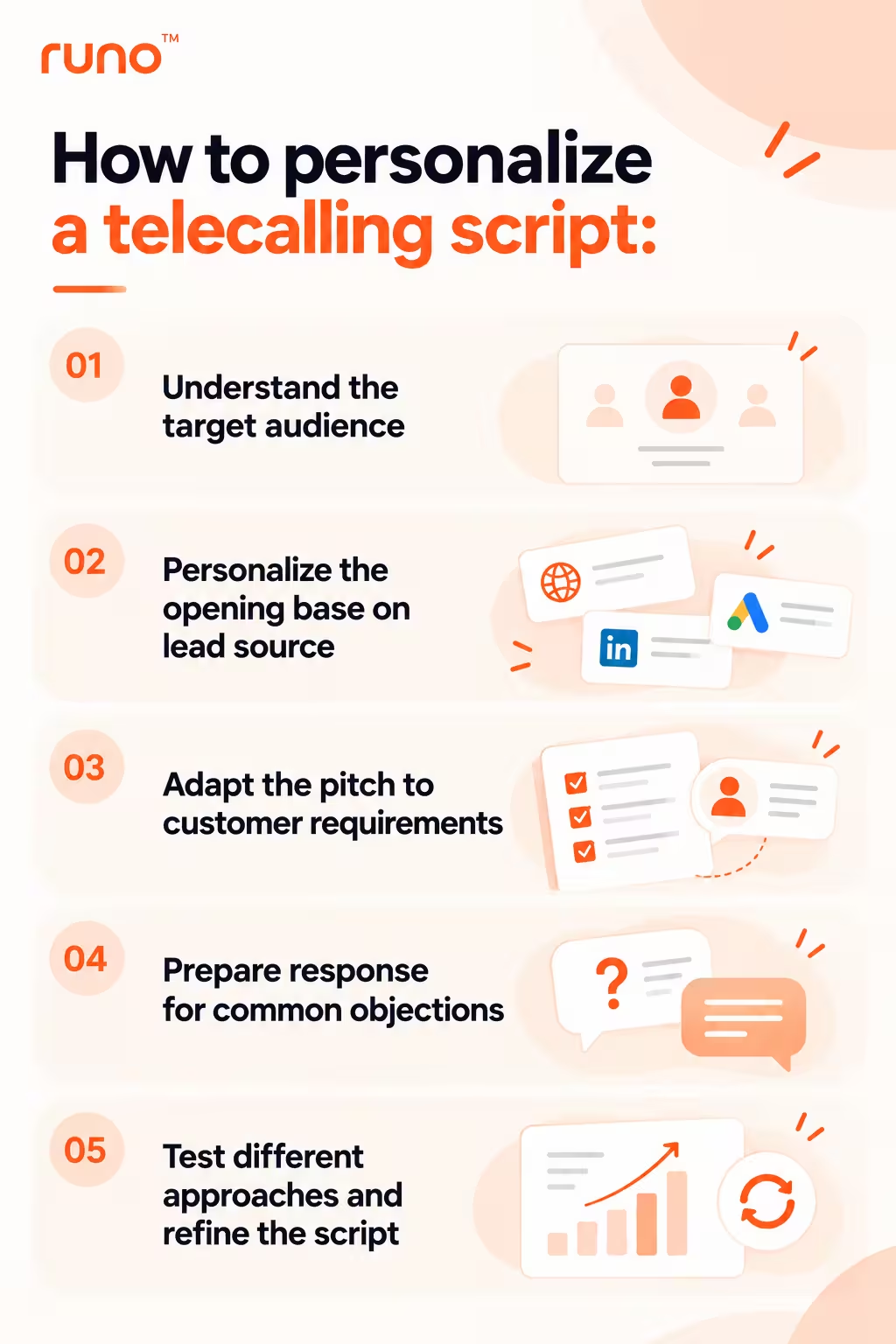
Understand your target audience
A factory owner, a clinic manager and a startup founder may have entirely different requirements, even if they're evaluating the same product.
Understand their industry, responsibilities and likely challenges before preparing your opening statement. This helps you ask more relevant questions and avoid unnecessary explanations.
Personalize the opening based on lead source
The reason for calling should reflect how the prospect entered your sales pipeline.
- Cold lead: “Hello, Mr. Nair. This is Pooja from ABCFirm. We work with HR teams at manufacturing companies that want to simplify payroll and attendance management. Is that something your team is currently exploring?”
- Warm lead: “Hello, Mr. Nair. This is Pooja from ABCFirm. Thank you for contacting us. Could you tell me a little about what you’re looking for?”
- Inbound enquiry: “Hello, Mr.Nair. This is Pooja from ABCFirm. Thank you for contacting us. Could you tell me a little about what you’re looking for?”
The product remains the same. The context changes the conversation.
Adapt your pitch to customer requirements
A ten-person business and a 400-person manufacturing plant are unlikely to have identical requirements.
Use the discovery stage to understand the prospect's needs, then focus on the features and benefits that address those requirements.
Prepare response for common objections
Review the objections your team encounters most frequently and prepare responses for each.
Practice them through role-playing exercises so that callers can respond naturally rather than searching for the right words during live conversations.
Test different approaches and refine your scripts
A script should evolve as your team learns more about customer behaviour.
Experiment with different openings, qualifying questions and closing statements. Compare the outcomes over a consistent period, and use actual call feedback to determine which changes are worth retaining.
Common Telecalling Mistakes that Can Affect Conversions
Even a well-written script can lose its effectiveness when the caller focuses more on delivering the lines than understanding the prospect.
Some mistakes happen during the conversation. Others occur after the call has ended.
Watch out for the following:
- Reading the script word for word: A rigid delivery makes conversations sound rehearsed and leaves little room for customer responses.
- Using generic introductions: Prospects need a clear reason to understand why you're calling.
- Talking more than listening: Long explanations can prevent callers from discovering what the customer actually needs.
- Pitching before understanding requirements: Presenting a solution too early can make the conversation feel irrelevant.
- Ignoring customer objections: Dismissing concerns can make prospects less willing to continue the discussion.
- Failing to record call outcomes: Without proper records, important customer information can get lost between interactions.
- Missing promised follow-ups: A prospect who expects a callback should not have to repeat the entire conversation.
- Calling without checking previous interactions: Repeating questions or contacting someone at an unsuitable time can affect the customer experience.
Most of these mistakes can be addressed through better preparation, regular call reviews and consistent follow-up practices.
How to Measure and Improve Telecalling Performance?
Six weeks after his first day, Arjun was making more confident calls. He knew how to open a conversation, ask relevant questions and handle common objections.
But Kavita had a different challenge. She managed a team of twelve and couldn't personally listen to every call.
She could see how many calls each representative made. What she couldn't easily determine was which conversations were productive, where prospects were dropping off and whether the team was following through on its commitments.
Call volume alone couldn't answer those questions.
To understand calling performance, sales managers need to look beyond the number of dials and evaluate the quality and outcomes of conversations.
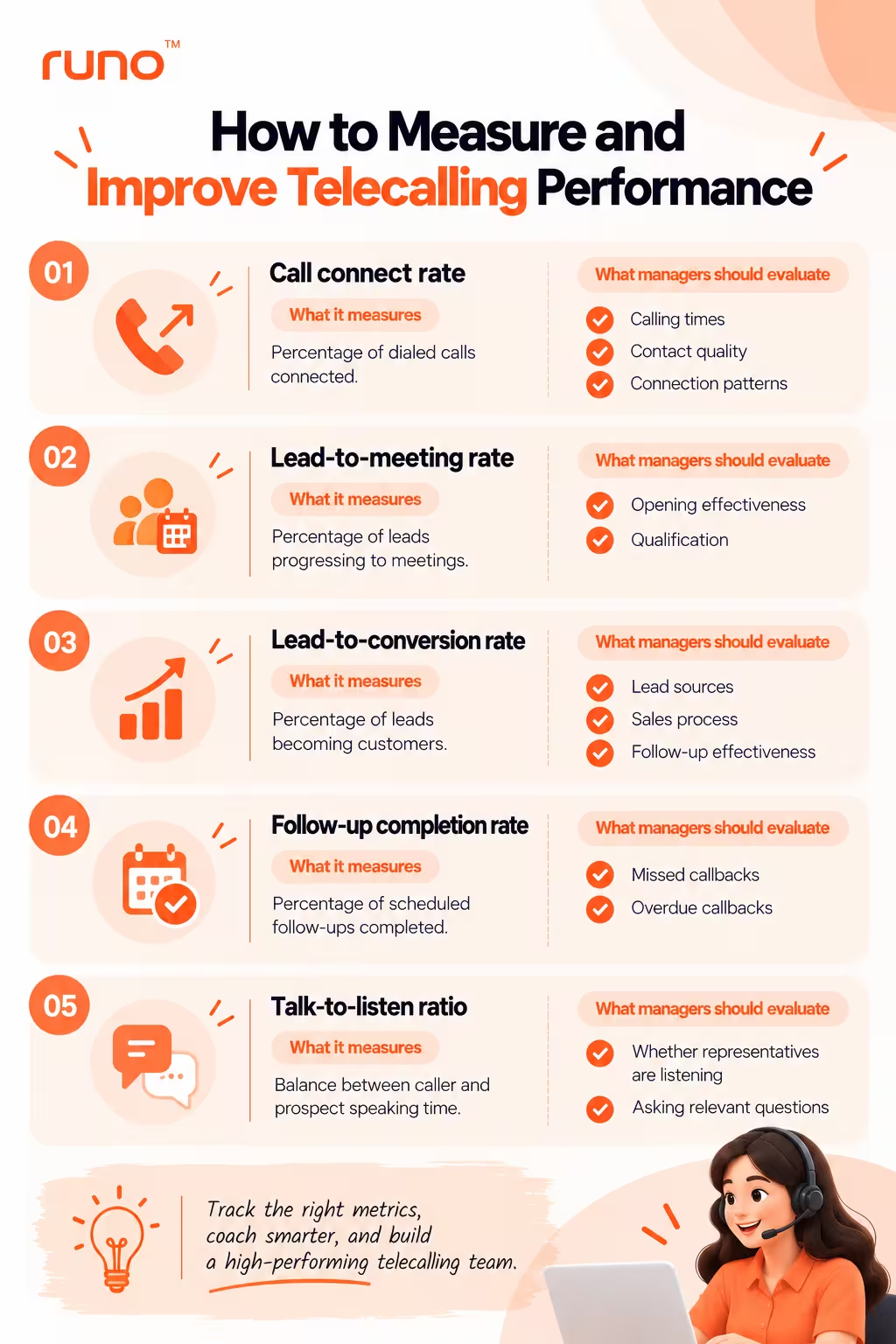
Call connect rate helps managers understand how effectively their teams reach prospects.
If representatives make several calls but connect with very few people, review calling schedules, contact quality and lead sources before changing the script.
Monitor Lead-to-Meeting and Lead-to-Conversion Rates
These metrics show how effectively conversations move prospects through the sales process.
A low lead-to-meeting rate may indicate issues with the opening, qualification or appointment-setting approach. A low lead-to-conversion rate after meetings may point to gaps in the proposal, product fit or subsequent follow-ups.
Review Call Quality and Conversation Outcomes
Call recordings and transcripts help managers understand what happens during actual customer interactions.
They can review how representatives introduce themselves, whether they ask relevant questions and how they respond to objections. AI-generated summaries and call quality insights can make it easier to identify recurring patterns and coaching opportunities.
Track Follow-Ups and Missed Opportunities
A promised callback is part of the customer interaction, not an optional task.
Track whether representatives complete scheduled follow-ups, update lead records and capture the outcome of each conversation. This helps managers identify where opportunities are being overlooked.
Identify High-Performing Scripts and Calling Approaches
Compare results across different representatives, lead sources and calling approaches.
For instance, one opening may work better for inbound enquiries, while another may generate more engagement during cold calls. Use actual outcomes to understand what works and refine the scripts accordingly.
Managers can also use a simple call review checklist to evaluate individual conversations.
| Review parameter | What to check |
| Opening | Did the representatives introduce themselves clearly? |
| Relevance | Was the reason for calling specific? |
| Discovery | Did the representative understand the customer’s requirements? |
| Objection handling | Were concerns addressed appropriately? |
| Closing | Was a clear next step agreed upon? |
The goal is not to make every representative sound identical. It's to help the team maintain consistent communication while allowing individuals to adapt their approach.
How Runo Helps Sales Teams Improve Calling Performance?
A good script gives your team direction. But knowing whether conversations are happening consistently, how prospects respond and whether promised follow-ups are completed requires visibility into everyday calling activity.
Runo is an AI Calling Intelligence Platform that combines SIM-based and cloud calling with CRM workflows and AI-powered conversation insights.
With Runo, sales managers can:
- Track calls and conversations: Access call records and recordings to understand customer interactions.
- Review call quality: Use AI-powered call analysis to identify conversation gaps and coaching opportunities.
- Understand customer interactions: Access AI-generated call summaries and sentiment insights.
- Manage leads and follow-ups: Keep customer information, calling activity and follow-up tasks organised.
- Monitor team performance: Get visibility into calling activity and individual team performance.
Instead of relying only on call volumes and individual updates, managers can use actual conversation insights to understand what needs improvement and where their teams may need support.
Wrapping it Up
Three months after his first morning on the sales floor, Arjun was helping a new team member prepare for her first set of calls.
He handed her the script, walked her through the opening and explained how to handle a few common objections. Before she started, he offered one final piece of advice: understand the script, but don't spend the call trying to remember every word.
He had learned what Kavita wanted him to understand from the beginning. A good telecalling script isn't about saying everything correctly. It's about knowing what to say, recognising when to listen and understanding how to move the conversation forward.
Whether you're making cold calls, following up with interested prospects or managing an entire sales team, the same principle applies. Prepare well, stay attentive and use real customer interactions to improve your approach.
And when your team grows, make sure you have the visibility to understand what's happening across those conversations. That's where the right calling intelligence platform can make a difference.
Frequently Asked Questions (FAQs)
What should I say first when making a telecalling call?
Introduce yourself and your company, explain why you're calling and ask whether it's a good time to talk. Keep the opening short, polite and relevant to the prospect.
How do I start a telecalling conversation in English?
Greet the prospect, state your name and company, explain the reason for calling and ask permission to continue. Adapt your language to the customer's preference.
What are the five steps of a good telecalling script?
The five core components are an opening, reason for calling, discovery question, value statement and clear next step. Handle objections whenever they arise during the conversation.
How do I convince a customer over the phone?
Understand the customer's requirements, explain how your offering addresses them and respond to concerns honestly. Focus on relevance rather than pressuring the prospect to make a decision.
How long should a telecalling script be?
A script should be long enough to guide the conversation but short enough to use naturally. Keep the opening brief and prepare separate responses for common objections.
How do I handle rejection during telecalling?
Acknowledge the prospect's response, understand the reason if they're willing to share and end the conversation politely. Record the outcome and avoid unnecessary repeated calls.
Should telecallers follow a fixed script for every customer? ?
No. Scripts should provide a consistent structure, but callers must adapt their wording and questions to the prospect's requirements, responses and stage in the buying process.