

It’s 4:47 pm on a Friday. Think of the customer who started a query on WhatsApp on Wednesday, got cut off mid-conversation, emailed on Thursday when nobody replied, and is now calling in, visibly annoyed because they now have to explain the entire issue again from scratch. On top of that, the agent who picks up has no idea any of this happened and puts them on hold for the third time. That thirty-second exchange is where churn quietly begins. Frustrating for the customer, expensive for you, and entirely avoidable.
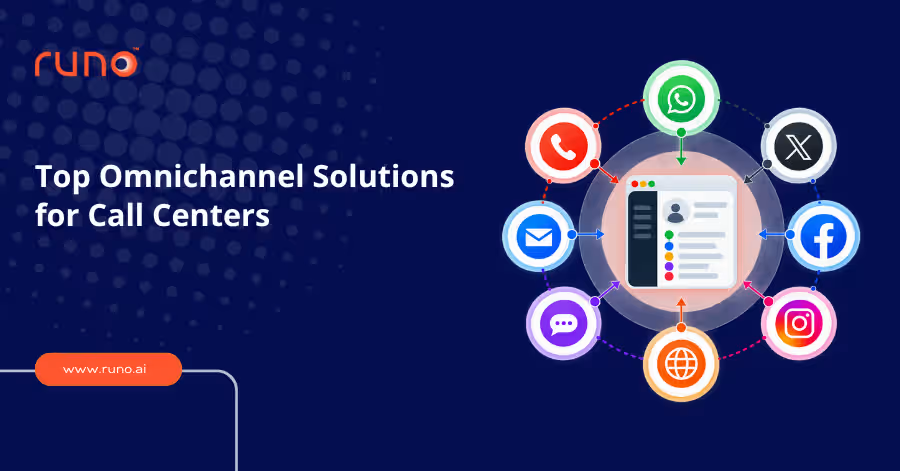
This is exactly the gap that omnichannel solutions for call centers are built to close. Rather than treating phone calls, email, live chat, messaging apps, and social media as separate silos, an omnichannel approach follows customer history end to end, so support executives always have the full picture and customers never have to repeat themselves.
Comparing 7 Omnichannel Solutions for Call Centers
Seamless service between communication channels is a basic expectation of doing business. This is why the share of companies investing in an omnichannel jumped from around 20% in 2012 to more than 80% within less than a decade, according to PwC’s global "Experience Is Everything" research.
Choosing an omnichannel call center software shouldn’t require a six-month evaluation cycle. With dozens of vendors in the market, separating genuine ones has become its own full-time job. We’ve cut through it for you.
1. Runo
Runo was built on the opposite premise from most enterprise suites: that omnichannel shouldn’t be complicated to deploy. No six-figure setup cost, no lengthy configuration rollout that needs a dedicated IT or admin team. As a mobile-first, AI-powered call management CRM, it brings SIM-based and cloud calling, WhatsApp, and CRM data into one lightweight app. Outbound agents dial through real mobile SIM networks. Runo’s own published data puts it at a 78% call connect rate, which is more than double what’s typical for cloud telephony.
What sets it apart:
- One customer, one history. Agents never start a conversation blind since every call, WhatsApp message, and note sits on the same timeline in real time.
- Conversations are automatically transcribed, summarized, and scored, which flags frustrated, at-risk customers.
- Live performance dashboards through Runo’s call center monitoring software, giving supervisors real-time visibility instead of end-of-day reports.
- WhatsApp built in as a first-class channel, run campaigns from a single business number, with a unified inbox sitting inside the same CRM your calling team already uses.
- Intelligent reminders make sure a lead who went quiet on WhatsApp doesn’t fall out of your pipeline just because the next touchpoint happened to be a phone call.
Runo is ideal for high-velocity sales teams, telecallers, and growing SMBs looking for high call connect rates without heavy infrastructure costs. Explore the full suite on the Runo call center app page.
2. Genesys Cloud CX
Genesys Cloud CX is a long-established name in enterprise-grade contact center software that offers deep AI-powered orchestration across voice and digital channels.
- It’s built for organizations with complex routing logic, heavy custom CRM integration needs, high security compliance, and dedicated IT and CX teams to manage implementation and ongoing administration.
- However, the deployment and configuration take weeks, and the platform’s depth can be more than smaller teams need.
3. NICE CXone
NICE CXone is built for large teams and dedicated administrators as it pairs omnichannel support with strong workforce management and analytics.
- It is helpful for enterprise operations that need deep reporting
- It offers good channel coverage.
4. Five9
Five9 is preferred by organizations where voice remains the dominant channel and digital channels are a secondary priority.
- It is known for its intelligent, skills-based call routing capability for both inbound and outbound calls.
- Additionally, it features advanced predictive dialers for large-scale cold outreach campaigns, IVR flows, and integration with Salesforce, Oracle, and ServiceNow.
5. Zendesk Talk
Since Zendesk Talk integrates phone support directly into its ticketing system, ticket creation from call logs and voicemail transcripts is easy.
- Support agents can switch from live chat or email tickets to phone conversations within the same browser interface.
- It’s a good option for SaaS and product-led businesses whose support operation is fundamentally ticket-driven rather than call-driven.
6. Freshdesk Omni
Freshwork's helpdesk platform with omnichannel ticketing across voice and digital channels highlights easy & affordable setup, suitable for small to mid-sized support teams.
- Freddy AI agent can read customer intent and resolve common queries across chat and email autonomously.
- Its collaboration tools help agents use internal discussion threads and linked sub-tasks on customer tickets.
7. RingCentral Contact Center
RingCentral combines phone calls, messages, and video conferences with contact center operations for businesses already within its ecosystem.
- It offers broad coverage with over 20 digital channels.
- Its voice trunking feature helps mid-sized organizations that want one provider for both internal employee communication and external call management.
| Platform | Best For | Standout Feature | Setup Time | Mobile-First |
| Runo | High-velocity sales teams & growing SMBs | 78% SIM-based call connect rate and built-in AI insights | Under 30 minutes | Yes |
| Genesys Cloud CX | Large enterprises | Deep AI-powered channel | Weeks | Partial |
| NICE CXone | Workforce optimization at scale | Analytics and workforce management depth | Weeks | Partial |
| Five9 | High-volume, voice-first outbound | Predictive dialers for inbound/outbound routing | Weeks | Partial |
| Zendesk Talk | Ticket-driven SaaS support teams | Built-in integration with Zendesk ticketing | Days-Weeks | Partial |
| Freshdesk Omni | Lean, cost-conscious support teams | Affordable omnichannel ticketing | Days | Partial |
| RingCentral Contact Center | Teams already on RingCentral’s UC stack | 20+ digital channels with voice trunking | Weeks | Partial |
Why Omnichannel is the Perfect Solution for Contact Center
Customers expect more than a phone line and a support inbox. While presence isn’t a problem in a typical multichannel setup, disconnection is. So, the real cost shows up as lost context between handoffs, longer hold times, and customers quietly leaving instead of bothering to complain.
To stay competitive, organizations are shifting from traditional voice-only or fragmented setups to a modern omnichannel platform.
Retention
Retention is what drives repeat business. Customers think in conversations, not in channels. If your systems can’t keep up, you risk losing not just the sale, but the customer entirely.
- As found in Forrester’s 2024 Omnichannel Difference Report, 45% of firms with omnichannel support see better customer engagement. 35% retain, and 46% see a rise in customer lifetime value.
- Companies with omnichannel routes retain 91% of their customers, according to analyst firm Aberdeen Group, which dwarfs retention for businesses still running disconnected, channel-by-channel support.
Impacts Customer Experience
Satisfactory consumer experiences show up on the balance sheet. According to contact center benchmarking research from SQM Group, the CSAT score for disconnected multichannel-only setups is around 28%, compared with roughly 67% for businesses running connected support systems. That’s the difference between a business customers recommend and one they merely tolerate.
According to research from Deloitte Digital, businesses that adopt dedicated omnichannel report an average 9% drop in cost per contact, alongside better agent occupancy and faster resolutions.
Other Key Capabilities
- Single timeline with call history, recordings, WhatsApp messages, emails, and agent notes in one place.
- Automatically routes inquiries from forms, chats, or inbound calls to agents based on skill sets, workload, or lead stage.
- Provides flexibility to place high-volume calls using mobile SIMs or cloud telephony, without being tethered to desk hardware.
- Agent monitoring, call connect rates, AI-generated transcripts and summaries, and conversation sentiment scoring.
With so many contact center omnichannel solutions in the market, it pays to know exactly what to look for before you commit to optimize your team’s outbound operations. Our guide on outbound call tracking for sales teams digs deeper.
How Runo could be the Perfect Omnichannel Software for a Call Center
Most omnichannel contact center platforms require weeks of implementation, dedicated IT support, and steep licensing costs, which is overkill for growing teams who only need their conversations connected. Runo skips all of that with a single mobile-native app. From solo founders to teams of 100+, anyone can start with basic call tracking and layer on omnichannel features as they scale.
Book a demo with Runo or start a 10-day free trial and go live in minutes, with no upfront capital expenditure! To learn more about cost-effective setups, read our analysis on the best telecalling CRM software for modern sales teams.
Conclusion
If you’re evaluating whether to invest in an omnichannel upgrade this year, these three questions cut through most of the noise:
Can an agent see a customer’s full cross-channel history in under five seconds? If not, you’re running multichannel, not omnichannel; no matter what the vendor calls it. With Runo, every call, WhatsApp message, and note lives on one timeline by default, not as a paid add-on.
How long would it genuinely take to go live? Weeks-long enterprise rollouts often mean months of continued revenue leakage while you wait. Runo skips that tax entirely. You can sign up and within about 30 mins, it’s ready to go.
Does the platform work for agents who aren’t at a desk? Field sales teams and remote support reps are often the biggest blind spot in "omnichannel" platforms designed around fixed office lines. Choosing the right omnichannel call center solutions should make conversations easier to manage, not harder. Runo was built mobile-first from the ground up. So, your agents can work from anywhere with no technical support.
FAQ
What is the difference between multichannel and omnichannel call center software?
Multichannel software offers several communication channels like email, phone, and chat, each one operating independently. Omnichannel connects all into a single shared history, which helps agents gain better context of the query regardless of where the conversation with the customer started.
Is omnichannel software only suitable for large contact centers?
No. Though large enterprises do use omnichannel platforms, solutions like Runo are built specifically for smaller and mid-sized sales & support teams who don’t wish to afford enterprise complexity from day one.
Do all these platforms support WhatsApp and messaging apps, not just voice and email?
Coverage varies extensively. Runo includes WhatsApp as a native integrated channel alongside calling, while other platforms on this list support messaging to varying degrees, with some even requiring add-ons.
How long does it typically take to implement an omnichannel contact center platform?
Enterprise platforms often take several weeks to configure and roll out. Mobile-first, cloud-based tools like Runo are designed for much faster deployment, often with teams operational within a day.
Is it worth switching platforms if we already use a multichannel setup?
If your current setup requires agents to manually cross-reference separate tools for calls, email, and messaging, the cost is likely already showing up in resolution times and customer satisfaction. Given how significant the retention and lifetime-value gains from true omnichannel adoption tend to be, most growing teams find the switch pays for itself.