

Your team needs AI sales assistant software for one simple reason: reps are spending more time on notes than on actual selling.
The AI sales assistant software market was valued at USD 3.01 billion in 2025, according to Market Research Future , and it’s growing at 23.16% a year. This guide covers what these tools do, what separates a useful one from an expensive one, and which options are worth your time in 2026. For a closer look at how this works in practice, see the Runo call management CRM for sales teams .
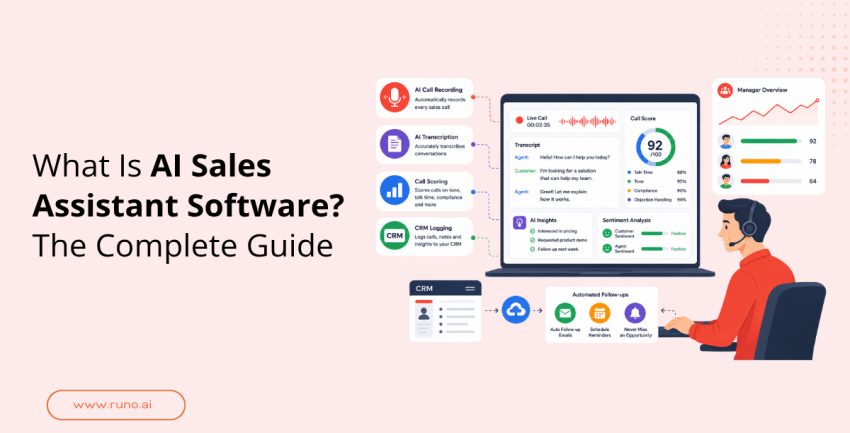
AI sales assistant software automatically records, transcribes, and scores every sales call your team makes. It logs the conversation to your CRM, flags follow-ups, and shows managers how each agent is performing across tone, talk time, and compliance, without anyone writing a single manual note. The best tools also track customer and agent sentiment separately.
Key Takeaways
- AI sales assistant software records, transcribes, scores, and CRM-logs every call automatically so your reps can focus on the conversation instead of the paperwork afterward.
- The global market for AI sales assistants is on track to exceed USD 20 billion by 2035, growing from USD 2.9 billion in 2025.
- SIM-based calling tools give high-volume outbound teams in India a meaningfully higher connect rate than cloud telephony setups.
- Runo scores every call on sentiment, filler words, talk time, and compliance with no manual input from the agent or manager.
- The right tool slots into your existing workflow on day one, with no process changes needed from your reps.
What Should Any AI Sales Assistant Software Actually Give You?
Before comparing tools, here is what serious AI sales assistant software needs to deliver to be worth your time:
- Automatic call recording and transcription with accurate speaker labels on every call
- A quality score per call calculated by AI, not manually entered by a manager
- Sentiment tracking for both the agent and the customer, measured separately
- Detection of talk time ratios, filler words, and loudness across every conversation
- Compliance checks measured against your internal call standards, not just generic defaults
- Searchable transcripts with keyword filtering so managers can find what they need in seconds
- Team-level dashboards showing performance by agent, by day, and by call outcome
If a tool you are evaluating can’t do all of these out of the box, you will hit that ceiling fast.
What Does AI Sales Assistant Software Actually Do?
AI sales assistant software records every call your team makes, turns it into a written transcript, scores it across multiple dimensions, and pushes the structured data into your CRM. It also identifies follow-up tasks from the conversation, flags unanswered customer questions, and gives managers a team-wide view of performance without anyone having to sit through hours of recordings. Your reps keep working the way they always have. The software runs in the background and handles everything else.
| Capability | What it does | Why your team feels it |
| Call recording | Captures every inbound and outbound call automatically | Nothing gets missed or disputed later |
| Call transcription | Produces a timestamped, speaker-attributed written record | Managers search by keyword instead of replaying calls |
| Call scoring | Rates each call out of 100 across multiple performance dimensions | Coaching becomes specific instead of vague |
| Sentiment analysis | Tracks emotional tone of both agent and customer separately | Managers spot disengaged customers before they churn |
| CRM auto-logging | Updates the contact record instantly with no agent input | Pipeline data stays accurate without chasing reps |
| Follow-up automation | Converts commitments made on the call into assigned tasks | Nothing falls through the cracks between conversations |
Teams using automated call scoring spend a fraction of the time on manual QA compared to teams still relying on spot-check listening, according to industry platform data.
What Should You Look for in AI Sales Assistant Software?
The right AI sales assistant software is the one that removes your team’s biggest daily friction, not the one with the longest feature list. Two teams with the same headcount can need completely different things depending on how their calls are routed, what their CRM looks like, and whether managers coach daily or weekly.
Three things consistently separate tools that stick from tools that get abandoned:
- Calling infrastructure fit: Cloud dialers depend entirely on internet stability. If your team works in areas with variable connectivity, SIM-based calling delivers a meaningfully higher connect rate. Check whether the tool supports the infrastructure your team actually uses day-to-day.
- Scoring you can configure: Default compliance checks work fine for generic teams. If your team follows a specific script or has compliance rules tied to your product or industry, you need a tool that lets you write your own evaluation criteria in plain language, not just toggle a preset list on or off.
- CRM sync that goes beyond a timestamp: Auto-logging is the baseline. The real question is whether the tool pushes structured data like call outcome, sentiment, and action items, or just a call duration entry that tells you nothing useful.
Understanding how call analytics works in practice helps you ask the right questions before you commit to any platform.
Scoring flexibility and CRM integration depth are the two features teams most often cite as gaps when switching away from enterprise tools.
Which AI Sales Assistant Software Tools Are Worth Comparing in 2026?
The seven AI sales assistant software tools below cover the main use cases in 2026: high-volume outbound calling, enterprise revenue intelligence, account-level call intelligence, live coaching, meeting-heavy cycles, prospecting automation, and real-time in-call support. Runo leads this list because it solves a connect-rate problem that the others don’t address.
The AI sales assistant software market exceeded USD 2.9 billion in 2025 and is projected to reach USD 20.5 billion by 2035, according to Research Nester . The fastest growth is coming from teams where calling is the core of the sales job.
| Tool | Best for | Real differentiator | Named proof point | Starting price |
| Runo | High-volume outbound, India | 2.3x higher connect rate via SIM-based calling, not internet-dependent | Trusted by 3,500+ businesses; Global Indian MSME of the Year, Bharat Nirmaan Awards | ₹599/user/month |
| Gong | Enterprise revenue teams | Pulls signals from calls, emails, and meetings into one revenue intelligence layer | Teams using Gong AI generate 77% more revenue per rep (State of Revenue AI, Dec 2025) | ~$1,400/user/year + platform fee |
| Chorus by ZoomInfo | Account-level call intelligence | Connects call data to ZoomInfo’s 100M+ contact database in real time | 2,988 verified G2 reviews as of 2026 | ~$8,000/year for 3 seats |
| Dialpad | Mid-market teams | Live in-call prompts backed by 100% uptime SLA and dual-cloud architecture | Honorable Mention, 2025 Gartner Magic Quadrant for CCaaS | $15/user/month |
| Avoma | Smaller teams, tighter budgets | Auto-joins meetings; “Ask Avoma” queries call data in plain language | 4.6/5 on G2 from 1,352 reviews; 97% renewal rate (SoftwareReviews, 2026) | $19/user/month |
| Salesforge | Outbound prospecting | Scores lead engagement signals so reps know who to call first | - | Custom |
| Revenue.io | Real-time in-call coaching | Moments live battlecard delivery during calls, Salesforce-native | 4.7/5 on G2 from 574 reviews; median contract $59,460/year (Vendr, 2026) | ~$75/user/month |
- Gong: Mandatory platform fee of $5,000 to $50,000 a year pushes first-year costs for a 25-person team to roughly $90,000 before implementation
- Chorus: Starts at $8,000 a year for three seats and typically takes two to three months to deploy fully
- Dialpad: 100% uptime SLA applies to Enterprise plans only, so verify your tier before signing
- Avoma: Less depth on compliance scoring and custom criteria than Gong or Runo, and not built for high-volume telecalling
- Salesforge: Focused on top-of-funnel prospecting, not call quality analysis
- Revenue.io: Built exclusively for Salesforce, so teams on HubSpot or any other CRM won’t get full value
For a broader look at how monitoring fits into your stack, see top call monitoring software in 2026 .
The tools teams actually use every day are the ones that don’t ask agents to change how they already work. That’s the one thing every tool on this list that sticks has in common.
How Do AI Sales Assistants Help Sales Teams Hit Their Targets?
AI sales assistants close the gap between the just-completed call and the next action. Here’s where most teams feel that gap most sharply:
| Problem your team has | What AI does | What changes |
| Reps spend 30–45 minutes a day writing call notes | Auto-generates a written summary after every call | Reps move to the next conversation faster |
| Follow-ups get missed when the pipeline is busy | Converts in-call commitments into assigned tasks automatically | No lead goes cold because someone forgot |
| Managers can’t coach without listening to recordings | Scores every call and flags specific moments worth reviewing | A manager with 10 reps prepares for coaching in minutes, not hours |
| New reps don’t know what good looks like | Top-call benchmarks and compliance scores are visible to everyone | Training uses real data, not guesswork |
Telecalling teams in India typically handle 80 to 100 calls per agent per day. Manually reviewing even 5% of those takes a significant chunk of a manager’s week. When AI sales assistant software automatically scores every call, managers stop firefighting and start coaching with purpose.
Teams that switch from manual call review to AI-scored summaries report a measurable drop in coaching prep time, with the biggest difference showing up in teams running more than 50 calls per agent per day.
Runo - AI Sales Assistant Software Built for Call-First Sales Teams
Runo won the Global Indian MSME of the Year in SaaS Sales Tech at the Bharat Nirmaan Conclave and Awards, making it the most recognized AI sales assistant software built specifically for high-volume calling teams across India.
The core differentiator is SIM-based calling. Cloud telephony connect rates fall when network connectivity drops. Runo routes every call over a real mobile SIM, which is why customers report a 2.3x higher connect rate than cloud telephony setups. For a team making 80 calls a day, that difference shows up directly in pipeline volume.
- AI CallInsights: Every call gets an automatic score out of 100, with breakdowns on sentiment, filler word count, talk time ratio, loudness, and compliance checks across 18 default parameters. Managers can also create fully custom criteria written in plain language, with their own weighting and scoring rules.
- Configurable scorecards: Managers set exactly how calls are scored to match their specific scripts, products, or compliance requirements, and every future call is automatically evaluated against those criteria
- Real-time team dashboard: Live call activity, daily agent scores, customer satisfaction splits, and performance rankings update continuously so managers always know what’s happening across the team
Track the call center metrics that matter to get the most out of Runo’s analytics layer.
Try Runo free for 10 days, no credit card needed.
Conclusion
The tools that actually move your numbers are the ones your reps open every single day, not just when a manager is watching.
AI sales assistant software works when it fits into how your team already calls. The real test isn’t which platform has the most features. It’s which one your reps use without being told to. If you want to see how that plays out in practice, the Runo call management app is worth a look.
So, what’s costing your team more right now: missed follow-ups, calls that never connect, or managers coaching blind?
Ready to See What AI Can Do for Your Sales Calls?
Most teams don’t know how many calls they’re losing until they see the data. Start your free Runo trial today and get AI call scoring, automatic summaries, and a real-time dashboard from day one, with setup under 30 minutes and no hardware needed.
FAQ
What is AI sales assistant software?
AI sales assistant software is a category of tools that records sales calls, converts them into searchable transcripts, scores agent performance, and updates your CRM without any manual input. It also identifies follow-up tasks, flags unanswered customer questions, and exports all structured call data directly to your CRM or any reporting tool you already use.
How does AI sales assistant software improve call quality?
Every call is scored on filler-word count, talk-time ratio, customer sentiment, and whether you followed key compliance steps. Managers can share specific moments from the transcript rather than giving vague, general feedback. A coaching conversation tied to a real call moment lands differently than one based on gut feeling.
Can AI sales assistant software work for small sales teams?
Yes, and smaller teams often see results faster because every single call carries more weight. Tools like Runo are priced per user from ₹599 a month, work on your existing mobile SIM, and take under 30 minutes to set up. You don’t need IT support or extra hardware to get started.
What is the difference between AI sales assistant software and a CRM?
Your CRM stores contact data and tracks where deals sit in your pipeline. AI sales assistant software analyzes the actual conversations that generate the data, scoring calls, detecting sentiment, and automatically pulling out action items. AI sales assistants push that structured data into your CRM so every contact record reflects what was actually said.
Do AI sales assistant software tools work with mobile or SIM-based calls?
Most platforms, including Gong, Chorus, and Revenue.io, are built for VoIP and web-based meetings only and don’t work with SIM-based or mobile calls. Runo is the exception: it is built natively for SIM-based calling and analyzes every mobile call with full transcription, scoring, and compliance checks.
How does Runo compare to other AI sales assistant software tools?
Most AI sales assistant software platforms are built for cloud telephony and US enterprise teams. Runo is built for teams that rely on call volume and need SIM-based calling for consistent connect rates in India. It scores every call automatically, shows managers a live dashboard, and starts at ₹599 per user per month, a fraction of what enterprise platforms like Gong charge before platform fees.