

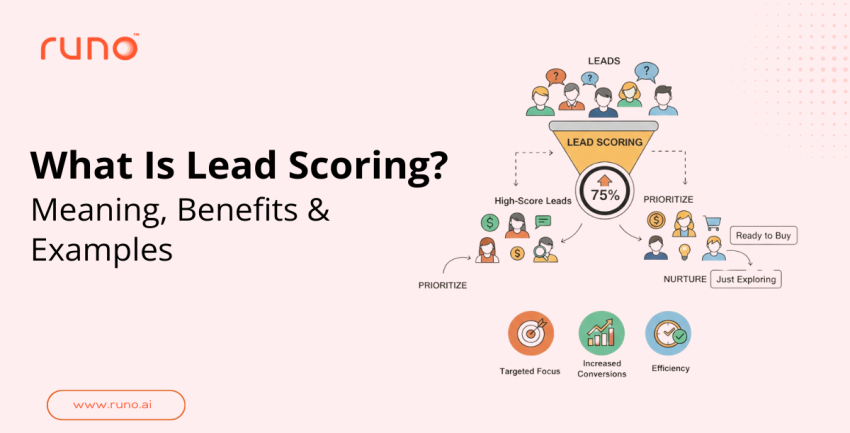
Your sales team is drowning in leads, but only 10–15% will ever become customers. How do you know which ones to call first?
Lead scoring is a sales methodology that assigns numerical point values to leads based on their demographic fit and behavioral engagement, helping teams prioritize prospects most likely to convert into customers.
It is a simple way to decide which leads deserve your attention first. It works by assigning each lead a score based on their likelihood of becoming a customer.
Think of it like this. Not every person who fills a form or visits your website is ready to buy. Some are just exploring. Others are seriously interested. Lead scoring helps you tell the difference.
So, how does it work?
You assign points to leads based on what you know about them and how they behave.
For example:
- Who they are (job role, company, industry)
- What they do (visiting your website, opening emails, booking a demo)
- How often do they engage with your brand
The more relevant and interested a lead is, the higher their score.
Why does this matter? Because your sales team has limited time. Instead of chasing every lead, they can focus on the ones that are most likely to convert.
In short:
- High score = hot lead
- Low score = needs more nurturing
Lead scoring helps marketing and sales work smarter, not harder. It brings clarity, saves time, and increases your chances of closing deals faster.
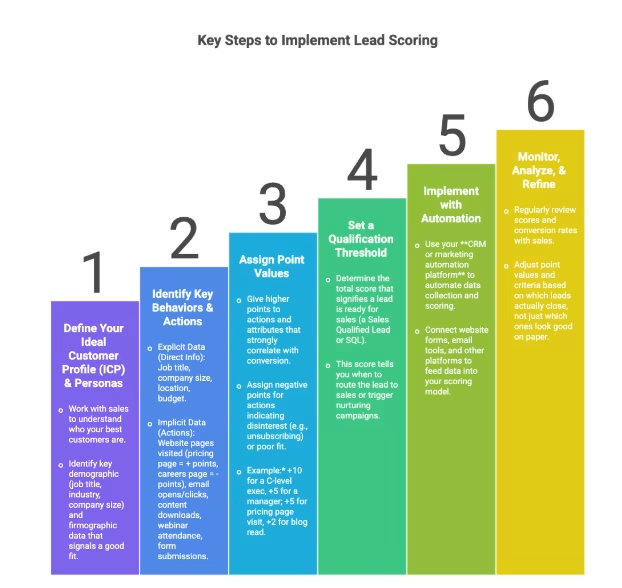
Why Lead Scoring Is Important for Sales Teams
Lead scoring does more than organise leads. It helps sales teams focus on the right conversations at the right time.
Better Alignment Between Sales and Marketing
Lead scoring works only when sales and marketing work together. Both teams must agree on one key question: What does a sales-ready lead look like?
Marketing defines the signals. Sales confirm the quality.
As leads move from marketing-qualified leads (MQLs) to sales-qualified leads (SQLs), regular check-ins are essential. If sales continue to receive leads that aren’t ready to buy, the scoring needs to be fixed. This feedback loop keeps both teams aligned and accountable.
Stronger Sales and Marketing Strategies
When you build a scoring system, every interaction is evaluated. Is a website visit valuable? Does an email click matter? What about a demo request?
These questions force teams to rethink their strategy. Once the ideal SQL is clear, marketing can design campaigns that push leads closer to conversion. Sales gets better leads. Marketing gets clearer direction.
Higher Revenue and Efficiency
Lead scoring helps sales teams spend time where it matters most. High-intent leads get priority. Low-quality leads get nurtured, not chased.
The impact is measurable. According to MarketingSherpa, companies that excel at lead nurturing generate 50% more sales-ready leads at 33% lower cost. Meanwhile, research from Forrester shows that organizations with strong sales and marketing alignment achieve 36% higher customer retention rates and 38% higher sales win rates.
The result? Less wasted effort, better conversions, and higher ROI from every lead generated.
Key Benefits of Lead Scoring
Implementing lead scoring delivers measurable advantages:
- Increased sales productivity: Reps spend time on high-intent leads instead of chasing dead ends
- Shorter sales cycles: Prioritizing ready-to-buy leads accelerates deal velocity
- Higher conversion rates: Focusing on qualified leads improves win rates by 20–30%
- Better marketing ROI: Marketing can measure which campaigns generate the highest-scoring leads
- Improved sales and marketing alignment: Shared definitions of MQLs and SQLs reduce friction
- Reduced customer acquisition cost: Less wasted effort on unqualified leads lowers cost per deal
- Data-driven decision making: Scoring reveals which lead sources and behaviors predict revenue
Types of Lead Scoring Models
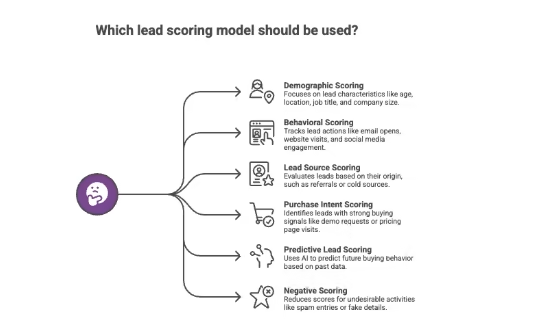
Not all leads should be scored the same way. Different models analyse different signals to assess fit, interest, and intent. Here are the most common types, explained simply.
Demographic Scoring
This model looks at who the lead is.
For B2C, it focuses on demographics such as age, location, and life stage. For B2B, it uses firmographics such as job title, company size, industry, and geography.
For example:
- A CIO from a mid-sized tech company may score higher.
- Someone outside your target industry may score lower.
This is also called explicit lead scoring because it uses information the lead shares directly. You can also enrich this data automatically instead of asking long-form questions.
Behavioural or Engagement Scoring
This model focuses on the lead’s actions.
Actions matter more than sign-ups. Opening emails, clicking links, visiting your website, or engaging on social media all signal interest.
For example:
- Frequent email opens = higher score
- No activity over time = lower score
This is known as implicit lead scoring because it’s based on observed behaviour.
Lead Source Scoring
Here, leads are scored based on their source.
Referrals, for instance, often convert better than cold sources. So they usually get higher points.
Sales and marketing teams should review this data together to keep scoring realistic.
Purchase Intent Scoring
This model tracks buying signals. Visits to pricing pages, demo requests, or repeated site visits indicate strong intent. You can also subtract points when engagement drops.
Predictive Lead Scoring (AI-Based Lead Scoring)
Predictive lead scoring uses artificial intelligence and machine learning to analyze historical customer data and automatically identify which leads are most likely to convert.
Unlike rule-based models where you manually assign points, AI-based lead scoring learns patterns from your past deals. It studies thousands of data points demographics, behavior, engagement timing, content interactions and identifies which combinations predict conversions.
Automated lead scoring takes this further by updating scores in real time as new data comes in. When a lead visits your pricing page, opens three emails in a week, or matches the profile of your best customers, the AI automatically adjusts their score without manual intervention.
This approach works best for companies with:
- Large lead volumes (1,000+ leads per month)
- Rich historical data (at least 6–12 months of closed deals)
- Complex buyer journeys with multiple touchpoints
Tools like HubSpot, Salesforce Einstein, and 6sense offer built-in AI-based lead scoring that continuously improves as your data grows.
Negative Scoring
Not all activity is good activity. Spam entries, fake details, or free email IDs in B2B contexts should reduce a lead’s score. This keeps your pipeline clean and focused.
Common Lead Scoring Mistakes to Avoid
Even well-intentioned lead scoring systems can fail if you make these common mistakes:
1. Overcomplicating Your Model from Day One
Starting with 30+ criteria and complex formulas creates confusion and makes it hard to identify what actually drives conversions. Begin with 5–7 high-impact criteria, test for 60–90 days, then add complexity based on results.
2. Ignoring Sales Team Feedback
Marketing builds the scoring model, but sales talks to the leads. If sales consistently reports that high-scoring leads are not sales-ready, your model is broken. Schedule monthly alignment meetings to review lead quality and adjust scoring rules.
3. Failing to Use Negative Scoring
Without negative scoring, your pipeline fills with competitors, students, job seekers, and spam entries. Subtract points for disqualifying factors: competitor domains (-50), personal emails in B2B (-10), unsubscribes (-20), and no activity for 90+ days (-5 per month).
4. Setting Your MQL Threshold Too Low
If 60% of your MQLs never convert, your threshold is too low. Analyze historical data: if only leads scoring 65+ convert at acceptable rates (15–25%), set your SQL threshold at 65, not 40.
5. Never Updating Your Scoring Model
Buyer behavior changes. New competitors enter the market. Your product evolves. Review your lead scoring model quarterly and adjust point values based on actual conversion data, not assumptions.
Lead Scoring Best Practices
Follow these best practices to build a lead scoring system that drives real results:
1. Start Simple, Then Refine
Begin with 5–7 core criteria that predict 80% of your conversions. Focus on job title, company size, and high-intent actions like demo requests. Add complexity only after your baseline model is working.
2. Align Sales and Marketing on Definitions
Both teams must agree on what qualifies as a Marketing Qualified Lead (MQL) and Sales Qualified Lead (SQL). Hold monthly reviews to ensure scoring thresholds match real-world conversion rates.
3. Use Negative Scoring to Filter Out Bad Fits
Subtract points for disqualifying factors: competitor domains (-50 points), personal emails in B2B contexts (-10 points), unsubscribes (-20 points), and job titles like ‘student’ or ‘intern’ (-10 points).
4. Implement Score Decay for Inactive Leads
Reduce scores by 10–25% each month when leads show no new activity. This prevents old, stale leads from clogging your pipeline and ensures recent engagement is prioritized.
5. Test and Update Your Model Quarterly
Lead scoring is not set-it-and-forget-it. Review conversion data every 90 days. If leads scoring 70+ are converting at 30% but leads scoring 50–69 convert at 5%, adjust your SQL threshold to 70.
6. Combine Fit and Engagement Scores
Don’t rely on demographics alone. A perfect-fit lead (high demographic score) who never engages is not sales-ready. Combine fit scores with behavioral scores for a complete picture.
7. Automate Scoring with Your CRM
Manual scoring does not scale. Use CRM tools like Runo, HubSpot, or Salesforce to automatically calculate and update scores in real time as leads take actions or new data is enriched.
Lead Scoring Criteria: What Should You Score?
When it comes to lead scoring, the real challenge isn’t a lack of data. It’s knowing which data actually matters.
The most effective lead scoring criteria come from three sources working together:
- Your sales team
- Your customers
- Your analytics
1. Insights from your sales team
Sales reps speak to leads every day. They know which conversations move deals forwardand which don’t.
They can tell you:
- Which emails spark replies
- Which resources help close deals
- Which leads look good on paper but never convert
Their input helps you score what truly drives action, not just activity.
2. Feedback from your customers
Customers often see things differently from internal teams. That’s why their perspective matters.
Talk to customers who:
- Converted quickly
- Took longer to decide
Ask simple questions:
- What convinced you to buy?
- Which content helped you trust us?
- What almost stopped you?
These answers reveal what influenced real buying decisions.
3. Data from your analytics
Analytics bring objectivity to the process. Use reports to track:
- Which content creates leads
- Which actions lead to conversions
- What users view before and after becoming a lead
Assign higher scores to actions that consistently lead to revenue. Lower scores for actions that show early or casual interest.
The key takeaway? Lead scoring works best when everyone is aligned, and decisions are backed by real behaviour, not assumptions.
How Lead Scoring Fits into the Sales Funnel
Lead scoring works like a smart filter inside your sales funnel. It helps teams understand who is ready to buy and who needs more time.
Instead of treating every lead the same, lead scoring shows where each person truly belongs in the funnel. This prevents sales reps from chasing unqualified leads and keeps the focus on high-potential prospects.
So, how does it fit into each stage?
Top of the Funnel: Attraction
At this stage, marketing brings in a large number of leads. But not all of them are the right fitor ready to buy.
Lead scoring steps in to separate interest from intent.
Middle of the Funnel: Scoring and Qualification
Here, leads are scored based on:
- Who they are (fit)
- What they do (behaviour)
High-scoring leads show buying intent. Low-scoring leads show curiosity, not commitment.
- High-score leads move closer to sales conversations
- Low-score leads enter nurturing campaigns like emails or educational content
Bottom of the Funnel: Conversion
Sales teams now focus only on the hottest leads. These leads convert faster because timing and intent are aligned.
Top 5 Lead Management Systems That Support Lead Scoring
Runo
Runo helps you track every lead from first contact to closure. It captures leads from multiple sources, auto-assigns them to sales reps, and updates lead status in real timemaking prioritisation and follow-ups faster and more effective.
Zoho CRM
Zoho CRM lets you capture leads from websites, events, spreadsheets, and field visits. With centralised lead data and scoring support, sales teams can quickly identify high-quality leads and ensure no opportunity is missed.
HubSpot CRM
HubSpot CRM offers free lead management with built-in lead scoring. It provides full visibility into each lead’s journey, automates lead routing, and helps sales teams prioritise high-intent prospects to drive better conversions.
Salesforce
Salesforce replaces spreadsheets with a powerful CRM designed for growing businesses. It helps capture, organise, and score leads efficiently, enabling sales teams to focus on the most promising opportunities using data-driven insights.
LeadSquared
LeadSquared combines lead capture, scoring, and automation in one platform. It tracks lead behaviour across channels, assigns scores based on intent, and helps sales teams engage faster with leads most likely to convert.
If you’re evaluating tools, this guide to the best CRM for lead management breaks down top platforms and helps you choose the right system for your sales needs.
How Runo Helps with Lead Scoring and Prioritisation
Runo simplifies lead scoring by giving sales teams complete visibility, speed, and control over every lead. Instead of guessing which lead to call first, Runo helps teams act on the most important opportunities at the right time.
Capture Every Lead, Instantly
Runo captures leads from multiple sources, such as websites, ads, marketplaces, and CSV uploads. The moment a lead comes in, it is recorded in the system. This ensures your team reaches out while interest is still fresh, not hours or days later.
Auto-Allocate Leads For Faster Response
New leads are automatically assigned to the right sales rep based on region, source, or custom rules. There is no manual sorting or delay. Faster allocation means faster conversationsand higher chances of conversion.
Track the Entire Lead Journey in Real Time
Runo tracks every update, follow-up, and status change in real time. Sales managers get a clear view of the pipeline, while reps know exactly which leads need immediate attention.
Stay on Top of Follow-Ups
Missed follow-ups often lead to lost deals. Runo sends timely reminders, so reps reconnect before leads lose interest. This keeps conversations active and momentum strong.
Improve Accountability With Team Tracking
Every call, message, note, and WhatsApp interaction is logged in a single timeline. Managers can easily see how leads are being handled and which ones are moving forward.
Engage Better With WhatsApp CRM
Runo’s WhatsApp CRM allows teams to run campaigns, send rich messages, and manage all chats from one unified inbox. Conversations across calls, emails, and WhatsApp stay connected, helping teams prioritise engaged leads.
To learn how WhatsApp CRM can boost engagement and conversions for small teams, check out our article on the benefits of WhatsApp CRM integration for small businesses .
FAQs
When should businesses start using lead scoring?
Businesses should start using lead scoring when lead volume increases and sales teams can’t follow up with everyone equally. If you generate leads from multiple channels or have longer sales cycles, lead scoring becomes essential.
What are the common lead scoring mistakes to avoid
Common mistakes include overcomplicating the scoring model, failing to align sales and marketing, overlooking negative scoring, and failing to update the scoring rules based on real results.
Is lead scoring only useful for B2B businesses?
No. While lead scoring is widely used in B2B, B2C businesses also use it to prioritise high-intent users based on behaviour, engagement, and purchase signals.
For teams focused on outbound outreach, check out our guide to the best CRM for telemarketing to find the right system that supports high-velocity calling and lead follow-up.
Can small businesses use lead scoring effectively?
Yes. Small businesses can start with simple lead scoring based on criteria such as engagement, lead source, and follow-up, then refine the model as they grow.